


Previous section → The World Before Completion
The second interpretation is that tohu and bohu both denote desolation, and the verse teaches that the earth—which includes the four elements—was at its creation desolate and void, and was covered with water. For this reason, it says tohu and bohu: tohu deriving from tehom (“deep”), indicating that the entire world was water, with no distinct forms yet in existence. There was also no light spreading over that deep, since the luminaries had not yet been created. Therefore, “the spirit of God”—a term referring to His will and the decree of His wisdom—was hovering and exerting influence over the face of the waters, whether the upper waters, in order later to form the firmament from them, or the lower waters, in order to gather them and reveal the dry land. And since all this required distinct stages, it is said: “Let there be light” (Genesis 1:3), in order to establish the differentiation of days. This, in my opinion, is the meaning of the verse.
Others have interpreted “the face of the deep” as the depth of the waters, with “face” referring to what lies below, at the center. And while the dry land had not yet appeared, the earth was called “darkness” on account of its obscurity, just as Scripture refers to the center of the earth as “a stone of darkness” (Job 28:3)1.
In the Zohar it is written: “How do we know that darkness is earth? As it is said: ‘in darkness his name is covered’ (cf. Kohelet 6:4)2. The Torah thus teaches that just as the depths of the waters received the form of darkness, so the upper waters received the form of spirit—hence: “and the spirit of God was hovering over the face of the waters,” referring to the upper aspect. Thus, that single primordial matter received different forms: in its middle part, the form of water; in its upper part, the form of spirit; and in its lower part, the form of darkness. The spirit is attributed to God in order to indicate its greatness, as it is the most elevated of the elements, and also on account of its subtlety.
As for why, according to this interpretation, the element of fire is not mentioned here, it is because the ancient thinkers held that there is no distinct element of fire. Rather, they considered the elements to be three: earth, water, and air, differentiated by their qualities—this one hotter, that one cooler. Thus, these three elements were thought to intermingle, and living beings to arise within each: those that walk upon the earth, those that swim in the water, and those that fly in the air. However, in the element of fire, living beings are not found, for existence does not come into being there. Therefore, the Torah mentions only the three perceptible elements, whose existence no one denies, and does not speak of fire, whose status was uncertain and not firmly established. This will be clarified further later on.
At the beginning of creation, when the Holy One, blessed be He, created the heavens and the earth, He did not wish to create the stars immediately—for a reason that I will explain in the fourth section.
Accordingly, when the elements are mentioned in Scripture, only these three are referred to: earth, water, and spirit. This may be seen in Book of Isaiah, where it says: “Who has measured the waters in the hollow of His hand… and comprehended the dust of the earth… who has directed the spirit of the Lord?” (Isaiah 40:12–13); and similarly in Book of Job, in the verses beginning: “For He looks to the ends of the earth…” (Job 28:24)3.
Genesis 1:3
Explanation of the nature of light and the term “speech”
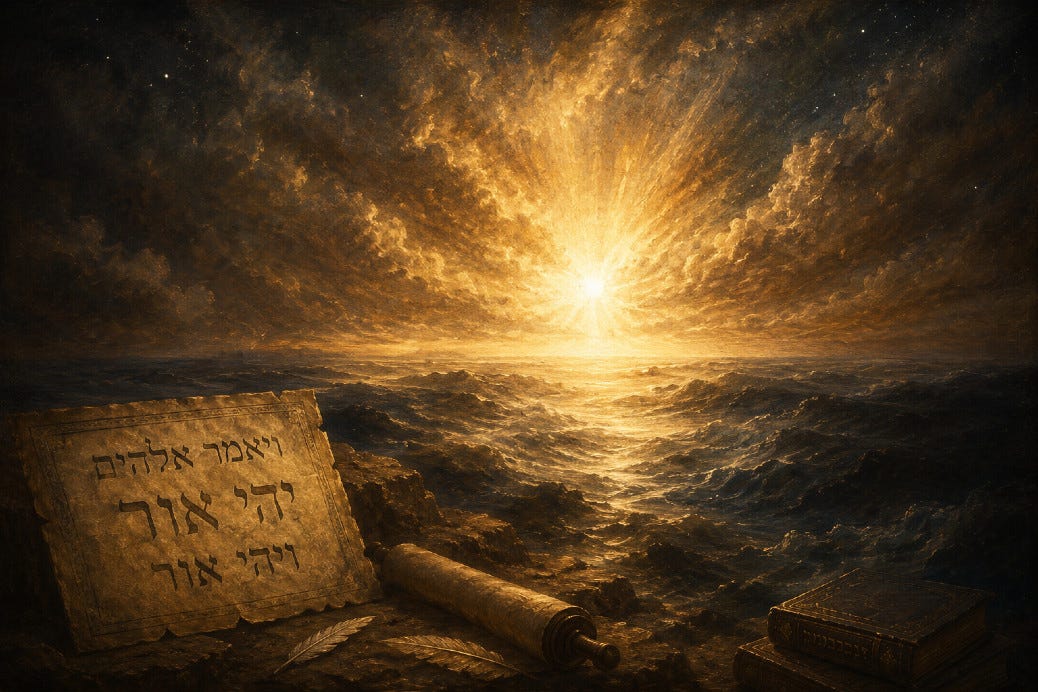
“And God said: ‘Let there be light,’ and there was light.”
The correct understanding, according to the plain sense of the verses, is that at the beginning of creation, when the Holy One, blessed be He, created the heavens and the earth, He did not wish to create the stars immediately—for a reason that I will explain in the fourth section. Therefore, it was necessary to bring forth another light that would serve during those first days, before the luminaries were created.
This light was needed in order to measure the days in which the works of creation were distinguished, each day according to its task. For a “day” is not defined or differentiated except by light. Moreover, the creation of light alludes to the act of creation itself, which came into being after absolute non-existence—just as light follows darkness, for light is a positive quality, whereas darkness is a privation.
Therefore, the First Emanator said: “Let there be light.”
Saadia Gaon wrote that the term “speech” (amirah) in the account of creation is used metaphorically for the divine will—that He willed it so. Likewise, Maimonides wrote similarly.
But Abraham ibn Ezra objected to this, arguing that if so, it would have been more appropriate to say “And God said that there should be light, and there was,” just as it says: “that every man should be ruler in his house”4 (Esther 1:22), that is, “according to the will of each man.”
Nachmanides wrote that bringing things into actuality is itself called “speech.” But this too is not correct. For if “And God said: ‘Let there be light’” were merely a metaphor for the emergence of light into actuality, then what would be the meaning of “and there was light”? The two expressions would be redundant, both referring to the same act.
(Parashat Bereshit — Genesis 1:1, Light Before the Stars in the Commentary of Don Isaac Abarbanel)
Next section →

