


Previous section → The Five Lights of Divine Effluence
Genesis 1:6
“And God said: Let there be a firmament in the midst of the waters…” until the end of the second day.
The questions that arise concerning these verses, according to their plain meaning and according to the views of the commentators, are as follows:
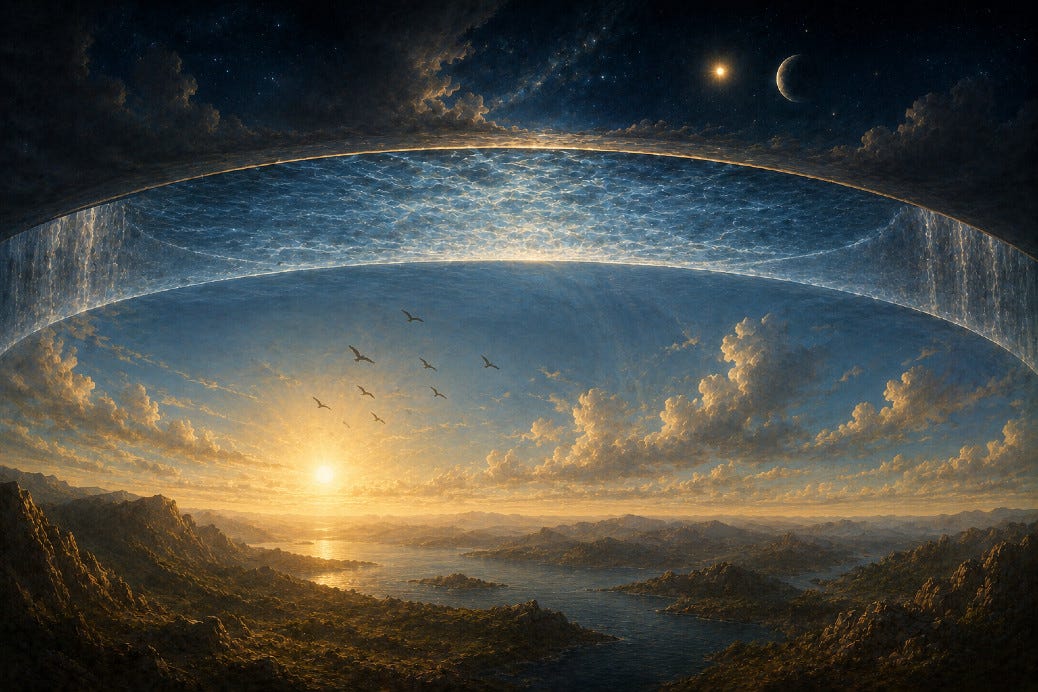
The first question concerns the nature of this rakia (“firmament”), which was made on the second day, given that the heavens had already been created on the first day. What is this firmament, and what are the waters above it?
You should know that on this matter there has been great confusion and a wide divergence of opinion among the later Jewish philosophers and commentators. From what I have seen in their writings, there are five principal views, corresponding to the five times the word rakia is mentioned in this section. I shall present them to you and point out the difficulties that arise from each.
Know further that we possess ten witnesses testifying to the true nature of the firmament1.
The first witness is the divine Torah itself, which says concerning the creation of the birds: “Let birds fly above the earth across the face of the firmament of heaven” (Genesis 1:20).
The second witness is what Scripture says concerning the luminaries: “Let there be luminaries in the firmament of heaven” (Genesis 1:14).
The third witness is the prophet Ezekiel, who says: “And the likeness above the heads of the living creatures was like a firmament, like the appearance of awesome ice...” (Ezekiel 1:22), and again: “Above the firmament that was over their heads was the likeness of a throne, in appearance like a sapphire stone” (Ezekiel 1:26).
The fourth witness is King David, who says: “The firmament tells the work of His hands” (Psalm 19:2), and: “Praise Him in the firmament of His might” (Psalm 150:1).
The fifth witness is Rabbi Eliezer ben Hyrcanus, who says in Pirkei de-Rabbi Eliezer: “Which is the firmament that was created on the second day? It is the firmament above the heads of the living creatures...”
The sixth witness is the statement in Bereishit Rabbah: “Where are the sun and moon situated? In the second firmament.”
The seventh witness is another statement there concerning the verse “’Let there be a firmament’: ‘The middle drop congealed, and from it the lower heavens and the upper heavens were made.’”
The eighth witness is the teaching of the Sages: “From the earth to the firmament is a journey of five hundred years,”2 and likewise the statement in Bereishit Rabbah: “The distance from the earth to the firmament is equal to the distance from the firmament to the upper waters,” together with other similar sayings.
The ninth witness is the statement in Bereishit Rabbah: “On the second day He created from the upper realms: ‘Let there be a firmament.’”
The tenth witness is the teaching that: “The Holy One, blessed be He, took all the waters of creation and placed half of them in the firmament and half in the Ocean Sea,” and likewise the statement that: “The edges of the firmament are attached to the Ocean Sea.”
Now, the view that is confirmed by all ten of these witnesses is the holy and true view. Any view that does not accord with all of them cannot be true, for all of these witnesses testify together concerning the truth of this matter.
Having set this before you, I shall now present the various opinions of the commentators regarding the firmament.
The first opinion is that the rakia (“firmament”) mentioned here is the highest sphere, encompassing all the others. Some of the ancient sages of the nations inclined toward this view. They maintained that this is the firmament above the heads of the living creatures seen by the prophet Ezekiel, that it is the firmament spoken of by Rabbi Eliezer ben Hyrcanus in Pirkei de-Rabbi Eliezer, and that it is the firmament referred to by the Psalmist when he says: “The firmament tells the work of His hands” (Psalm 19:2), and: “Praise Him in the firmament of His might” (Psalm 150:1).
How could it be imagined that the lower spheres were created on the first day—those included in the verse “In the beginning God created the heavens”—while the highest sphere that encompasses them all was created only afterward, on the second day?
This opinion, however, is incorrect.
For if the firmament mentioned in this passage were the first and highest sphere, what would be the meaning of the waters above it, as Scripture says: “and between the waters that are above the firmament” (Genesis 1:7)?
Moreover, how could it be imagined that the lower spheres were created on the first day—those included in the verse “In the beginning God created the heavens”—while the highest sphere that encompasses them all was created only afterward, on the second day?
This opinion is also contradicted by the first witness, namely the verse concerning the birds: “Let birds fly above the earth across the face of the firmament of heaven” (Genesis 1:20), for birds do not fly in the highest sphere.
Likewise, it is contradicted by the second witness concerning the luminaries, since the sun, moon, and stars are not situated in the highest encompassing sphere.
It is also contradicted by the seventh witness: concerning the verse ‘Let there be a firmament,’ it is said that ‘the middle drop congealed, and from it the lower heavens and the upper heavens were formed.’
Such a description cannot properly apply to the first celestial sphere—that is, the outermost sphere encompassing all the others.
The eighth witness also stands against this view, for the statement that the distance from the earth to the firmament is equal to the distance from one firmament to another cannot refer to the highest sphere.
Likewise, the tenth witness contradicts it, since the elemental waters are certainly not divided such that half are placed within the highest sphere.
Therefore, this opinion cannot be accepted in light of the testimony of the witnesses.
(Parashat Bereshit — Genesis 1:6, Ten Witnesses to the Nature of the Firmament in the Commentary of Don Isaac Abarbanel)
Next section →

