


Previous section → The Missing Angels and the Unity of Creation
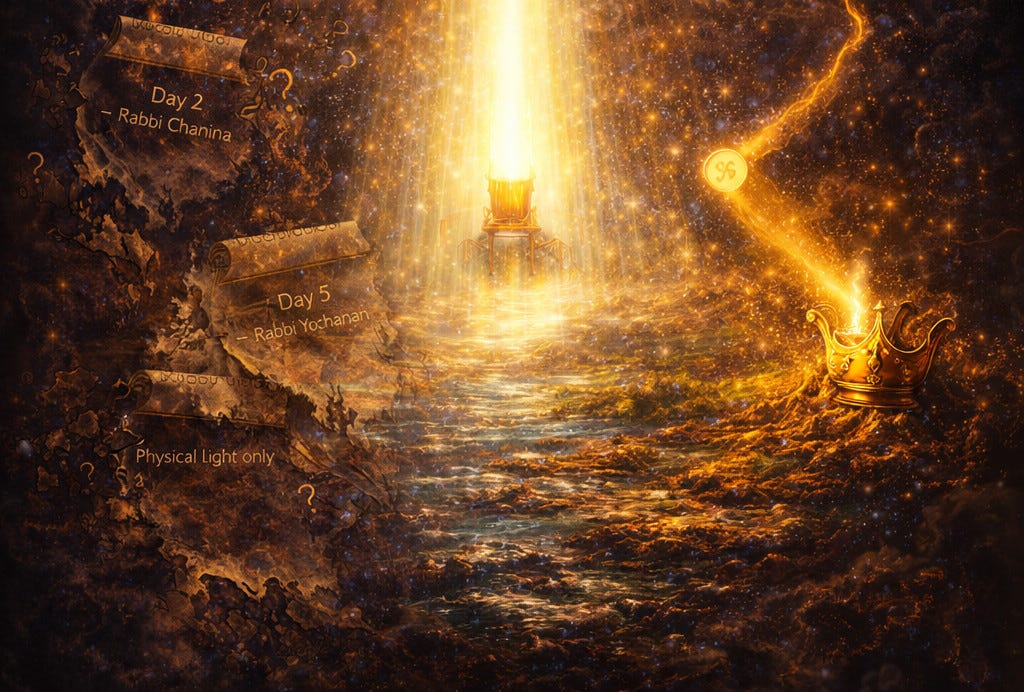
I said to myself: Let me turn to the great ones, the sages of the Talmud, for they are the ones who truly know the ways of God. I found in Bereshit Rabbah the following discussion: “When were the angels created?” Rabbi Chanina says: They were created on the second day, as it is written (Psalms 104:3-4), “He who roofs His upper chambers in the waters”, and “He makes His angels like winds.” Rabbi Yochanan says: They were created on the fifth day1, as it is written (Genesis 1:20), “And let the birds fly above the earth,” and it is also written (Isaiah 6:2), “And with two wings, he flies.” The Midrash then comments: “Whether according to the opinion of Rabbi Yochanan or Rabbi Chanina, nothing was created on the first day, so that one should not say: ‘Michael was stretching out the heavens in the south, Gabriel was spreading them in the north, and God Himself was measuring in the center.’”18 Rather, as it is written (Isaiah 44:24): “I am the Lord, who makes all things, who alone stretches out the heavens, who spreads out the earth by Myself.”
I say that these opinions clearly reveal their own weakness. How can it be that God created the heavens and the earth, water, wind, light, and darkness before creating the angels, according to the view of Rabbi Chanina? Even if the proof he brings is not decisive—meaning, just because it is written “He makes His angels winds” after “He roofs His upper chambers with water,” does not necessarily prove that they were created on the second day. After all, it is also written immediately afterward, “He established the earth upon its foundations,” and yet according to all opinions, the earth was created on the first day. Furthermore, Rabbi Chanina’s verse does not even explicitly state that angels were created on the second day, but only that they were created after the firmament. It remains entirely possible that this occurred on the third, fourth, or even later days.
According to Rabbi Yochanan’s opinion, there is also a difficulty: How could dry land have been revealed and vegetation have sprouted before the creation of angels? The proof he brings is based on a gezeirah shavah (an interpretive method that links similar words in different verses), yet it is well known that such a method is not accepted unless transmitted from one’s teacher in an unbroken tradition from Moses at Sinai. Since we find another sage who disagrees with this interpretation, it follows that this was not a universally accepted tradition. For this reason, Ramban does not accept it. Additionally, the reasoning provided by both sages—that angels were not created on the first day to prevent people from saying they assisted in creation—is not a compelling argument. If that were the case, their creation should have been delayed until after the creation of man, lest one claim that angels had a role in bestowing a soul upon him. From all of this, it appears that none of these explanations provide a fully satisfactory resolution to this question, based on the straightforward meaning of the text.
Another opinion is also found in the words of our sages, which states that the angels were created on the first day, along with the creation of light. The reasoning behind this view is that since our intellect is too limited to fully grasp the true nature of spiritual beings, the Torah compares them to light—due to their spiritual essence and their role as a source of intellectual perception. Just as physical light enables vision, so too, these elevated, spiritual beings serve as the source of intellectual comprehension.
So much so that because of this, it is said about Him, may He be exalted, (Psalms 27:1) “The Lord is my light and my salvation”—“The Lord is a light to me.” And this is what our sages, of blessed memory, intended when they said in Midrash Tehillim: Rabbi Simon said, “The Holy One, blessed be He, separated the light for Himself.” This is likened to a king who saw a beautiful coin and said, ʿThis is for me.ʾ” So too, when God created light, He said, “No creature can use it but Me,” as it is stated: “And light dwells with Him.” (Daniel 2:22) Ralbag (Gersonides) explains this Midrash in the following way: It is impossible to interpret this passage as referring to physical light, for how could one say that God reserved it for Himself, allowing no creature to use it? Rather, the sages were speaking of a spiritual, intellectual light, which is beyond physical perception.
Similarly, in Bereshit Rabbah, a disagreement is recorded between Rabbi Yehudah and Rabbi Nechemiah. One said: “Light was created first, and only afterward, the heavens and the earth.” The other said: “The heavens and the earth were created first, and afterward, light was created.” There is no doubt that they were not debating the nature of physical light. For how could one possibly suggest that physical, perceptible light was created before the world itself? Light, after all, spreads through the air as a reflection of the sun’s rays, illuminating the earth. If there was still no celestial sphere, no sun, no earth, and no air, then how could light exist? Rather, their discussion must have been concerning the separate intellects (sechalim nivdalim)—the spiritual entities beyond the physical world. Other statements in Midrash Rabbah also support this interpretation.
Ralbag (Gersonides), in his work Milchamot Hashem (The Wars of the Lord) and in his commentary on the Torah, explains that this primordial light refers to the separate intellects according to the literal reading of the text. However, in my view, this interpretation is completely unfitting and does not align with the straightforward meaning of the verses, for several reasons.
(Parashat Bereshit — Genesis 1:1, Primordial Light and the Question of Angelic Creation in the Commentary of Don Isaac Abarbanel)
Next section → Four Objections to Identifying the First-Day Light with the Angels
The dispute between Rabbi Chanina and Rabbi Yochanan (Bereshit Rabbah 1:3) arises from different hermeneutical approaches to biblical verses: Rabbi Chanina associates angelic creation with the second day, citing Psalms 104:3-4, which describes God’s upper chambers and angels as “winds.” Rabbi Yochanan links their creation to the fifth day, drawing from the parallel between flying birds and flying angels, as referenced in Yeshayahu’s vision of the seraphim (Isaiah 6:2). Abarbanel presents these opinions but does not explicitly favor one over the other.