


Previous section → The Firmament Beyond Meteorology
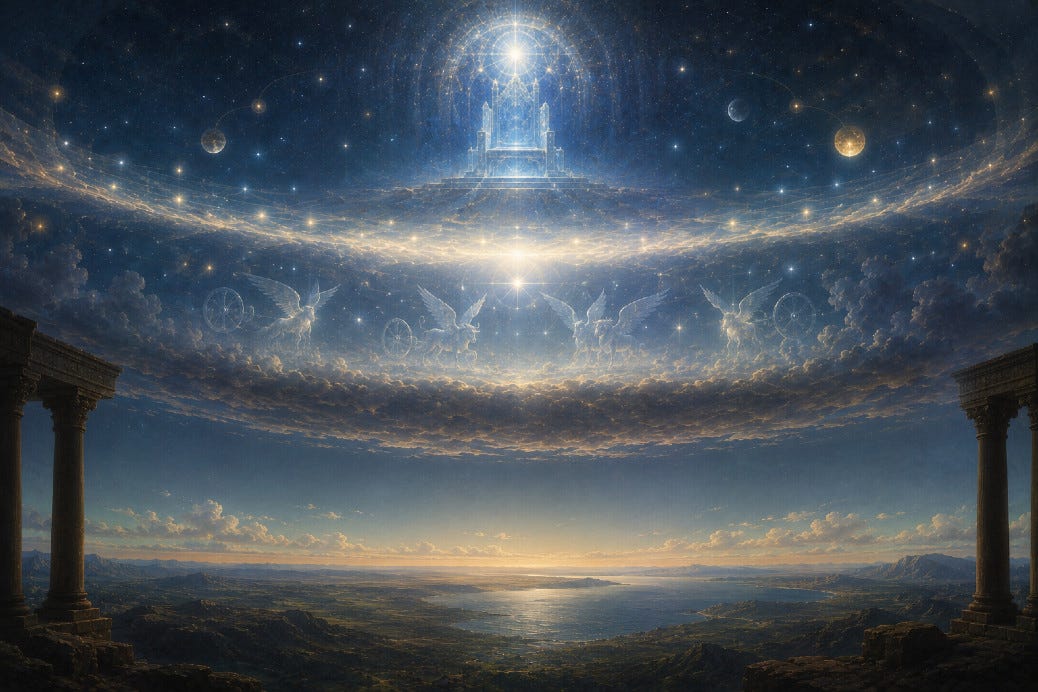
Likewise, the third witness is the vision of Ezekiel, who says that he saw a firmament above the heads of the living creatures, and above that firmament he saw the likeness of a sapphire stone, resembling a throne1. Can this possibly be interpreted as referring to the lower region of the atmosphere?
Indeed, all the proponents of this opinion interpret the living creatures as the celestial spheres. It therefore necessarily follows that the firmament above them must itself belong to the heavenly realm, not to the portion of the atmosphere in which we dwell.
The fourth witness is the statement of King David: “The heavens declare the glory of God, and the firmament proclaims the work of His hands” (Psalm 19:2).
Maimonides himself explains that this declaration and proclamation refer to intellectual apprehension, and from this verse he infers that the heavenly bodies are living, intelligent beings. How then can we say that the firmament is merely the lower atmosphere, close to mankind, dwelling among them amidst their impurities? Can we really claim that it is this atmosphere that proclaims the glory of God?
Likewise, the verse: “Hallelujah! Praise God in His sanctuary; praise Him in the firmament of His power” (Psalm 150:1) clearly refers, in my opinion, to the separate intellects by the expression “His sanctuary,” to the celestial bodies by “the firmament of His power,” and to the entire lower world by the following expression, “His mighty acts.” It is impossible to interpret the firmament mentioned there as the lower atmosphere2.
The fifth witness is found in Pirkei de-Rabbi Eliezer: “Which is the firmament created on the second day? It is the firmament above the heads of the living creatures.”
This must necessarily refer to something higher than the living creatures themselves, not to the atmosphere.
The sixth witness is the statement in Bereishit Rabbah that the sun and moon are situated in the second firmament. This cannot be interpreted as referring to the atmosphere.
Still less can the seventh witness be reconciled with this opinion. Bereishit Rabbah says: “When the Holy One, blessed be He, said, ‘Let there be a firmament,’ the middle drop congealed, and from it were formed the lower heavens and the highest heavens.”
Maimonides cited only the words: “The middle drop congealed,” interpreting them as referring to the atmosphere, but he omitted the conclusion of the passage: “and from it were formed the lower heavens and the highest heavens,” because he could not explain these words as referring to the atmosphere, for the atmosphere contains neither “the heavens” nor “the highest heavens.”
The eighth witness is the teaching: “From the earth to the firmament is a journey of five hundred years,” and likewise the statement in the Babylonian Talmud (Chagigah 13a) that: “The thickness of the firmament is equal to the distance from the earth to the firmament,” together with the other similar sayings.
Can the firmament mentioned in these passages possibly refer to the lower atmosphere, which reaches the earth and is joined to it? If so, how could the empty space between them amount to a journey of five hundred years?
Accordingly, the difficulty remains. Why should the lower atmosphere be called rakia, and likewise shamayim?
There is no doubt that Maimonides felt the force of these objections, for they could not have escaped his notice. Seeking to answer them, he wrote in the chapter already mentioned of the second part of the Guide: “Because of this shared designation, the true heavens are likewise called rakia or raki’im, just as the true firmament is called shamayim.”
His meaning is that the primary meaning of rakia is the lower atmosphere. But since that atmospheric firmament is also called shamayim in the verse: “And God called the firmament Heaven” (Genesis 1:8), it follows, according to him, that the true heavens may likewise be called rakia. Thus the word rakia in connection with the luminaries, in Ezekiel, in the Psalms, and in the sayings of the Sages would all refer to the actual heavens.
But you yourself can see how weak this explanation is.
A man is called adam because of his relation to the adamah (“ground”), yet we do not therefore call the ground adam. The same holds true for other names derived from something else: the original term is not in turn called by the derived name.
Accordingly, the difficulty remains. Why should the lower atmosphere be called rakia, and likewise shamayim?
(Parashat Bereshit — Genesis 1:6, The Heavenly Meaning of Rakia in the Commentary of Don Isaac Abarbanel)
Next section →

