


Previous section → The Singular Language of the First Day and the Meaning of “Tohu va’Vohu”
The truth is that if darkness is sometimes observed in the fire that burns within wood, it is due to the opacity of the material itself. This is not the case with primordial fire, which is not entangled with dense and coarse matter. Some of the ancient philosophers1 even claimed that there is no distinct element of fire at all, but rather that everything from the earth up to the celestial spheres consists of air. Its parts vary in their qualities—denser or more refined—based on their proximity to the center or to the outer spheres, but they do not differ in form. They are all ethereal (sphiriyim), neither luminous nor dark. Indeed, this view is the one most aligned with rational understanding, as will be explained later.
Even those who thought that fire was a distinct element from air still considered it to be more refined and ethereal than air. This would explain why the stars are visible at night and the sun during the day, for the farther a substance is from the earth and the closer it is to the heavenly sphere, the more refined and luminous it becomes. All of this proves that “darkness” in this verse does not refer to the element of fire2.
However, this is an unfounded claim, for the Torah does not present distant causal relationships but rather immediate ones.
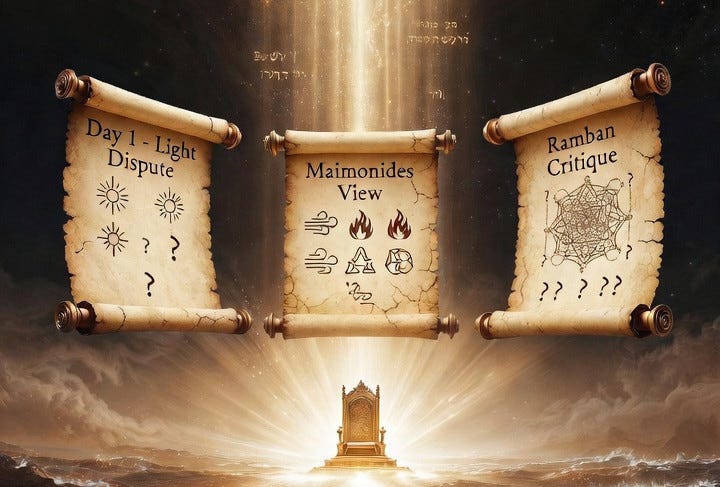
Some have explained “and darkness was upon the face of the deep” (tohom) to mean that the “deep” refers to the depths of the waters, whereas fire is not located adjacent to water, but rather above the air, not directly upon the water. Maimonides himself wrestled with this difficulty and suggested that since darkness (which he identified with fire) is above the air, and the air is above the waters, one could say that the darkness was upon the waters through the medium of the air.
However, this is an unfounded claim, for the Torah does not present distant causal relationships but rather immediate ones. If darkness were fire, it should have said, “And darkness was upon the face of the air,” for that is its natural place without any intermediary, not “upon the face of the deep.” And if the words of the Torah came through intermediaries, then one could just as well argue that darkness was upon the earth via the medium of air and water. Thus, darkness cannot refer to fire.
Similarly, regarding “the spirit of God was hovering over the face of the water,” Maimonides interpreted “spirit” as referring to the element of air, but this is incorrect. Nowhere in Scripture is “ruach” (spirit) used to denote the pure element of air; rather, it always refers to the moving wind, as is stated in the Book of Signs (Sefer HaOtoth)3, or to other things to which the Torah attributes the term “ruach.” as will be explained. If “ruach” here referred to the element of air, then why would it be attributed specifically to God, as in “the spirit of God was hovering”, whereas the other elements mentioned in creation are not similarly ascribed to Him? Moreover, the verses Maimonides cited to support his view—such as “A wind went forth from the Lord” (Numbers 11:31), or “You blew with Your wind” (Exodus 15:10)—all refer to the moving wind, not to the static element of air.
For all these reasons, I find no satisfaction in interpreting this verse as referring to the four elements. This raises the question: why are the elements not mentioned explicitly in the account of creation, given that they are the foundations of all physical existence? Furthermore, what is the meaning of this verse? The phrases “upon the face of the deep” and “upon the water” are not descriptions of creation, for they do not include the phrase “Let there be...”, as is used for all other created entities.
The Fifth Question
What is the light mentioned in this passage, according to the plain meaning of the text, and what is its nature? You should know that Maimonides, Ibn Ezra, and all who follow their approach believed that the light mentioned here is the very same light of the celestial luminaries that were created in the heavens. Nicholas de Lyra4, who interpreted the Torah for the nations, held this view as well. Ramban also referenced this interpretation as the opinion of “some commentators,” perhaps because he had not seen it explicitly stated in Guide for the Perplexed, and thus did not attribute it directly to Maimonides. Furthermore, you will find that even among the Sages of the Talmud, some wise scholars upheld this view. In Tractate Chagigah, the Sages stated that ten things were created on the first day, and among them, they counted light. They then raised the objection: “Was light really created on the first day? But it is written, ʿAnd God placed them in the firmament of the heavensʾ (Genesis 1:17), and it is written, ʿAnd it was evening, and it was morning, the fourth dayʾ (Genesis 1:19)!” The Talmud concludes with a dispute between Rabbi Yaakov, who stated that “the light that God created on the first day enabled man to see from one end of the world to the other; but the Sages say that these are the same luminaries that were created on the first day but were not suspended until the fourth day.” Thus far.
The simple reading of this passage suggests that some sages held that this light was an intellectual concept, referring to separate intellects (sechalim nivdalim)5, while others believed that the light was a physical phenomenon. However, as I have already demonstrated in the second question, it is inappropriate to interpret that the light in this passage as referring to angels.
(Parashat Bereshit — Genesis 1:1, Beyond the Four Elements: Reconsidering Darkness, Ruach, and the Light of the First Day in the Commentary of Don Isaac Abarbanel)
Next section → Why the First-Day Light Is Not the Light of the Luminaries
This idea can be traced to certain Greek philosophers who challenged the classical four-element theory. Notably, Aristotle maintained that fire was a distinct element, but later thinkers, including John Philoponus (6th century CE), questioned its independence, suggesting that fire might be a property of air rather than a separate substance.
In Aristotelian natural philosophy, the four elements (earth, water, air, fire) are arranged in layers, with fire considered more refined and luminous than air. Some philosophers held fire to be a distinct element, others as a quality of heated air, but all agreed it was ethereal and light-bearing. Thus Abarbanel argues that “darkness” in Genesis 1:2 cannot mean fire, since fire was by definition associated with light rather than obscurity.
Sefer HaOtoth (“The Book of Signs”) is a lesser-known work sometimes attributed to early Jewish scholars, but its precise authorship and contents remain unclear. It may refer to a medieval philosophical or mystical text discussing natural phenomena and divine signs.
Nicholas de Lyra (c. 1270–1349) was a Franciscan biblical scholar whose commentary on the Bible was deeply influenced by Rashi. His Postillae Perpetuae became one of the most widely used biblical commentaries in medieval Christian Europe. He sought to explain the Torah in a way that aligned with Christian theological perspectives while relying on Jewish exegesis.
The term sechalim nivdalim (“separate intellects”) refers to non-physical, purely intellectual beings, often identified with angels or celestial intelligences in medieval Jewish philosophy. This concept, influenced by Aristotle and later developed by Maimonides, describes beings that exist beyond the material world and govern the celestial spheres through divine will.