


Previous section → The Celestial Spheres on Trial
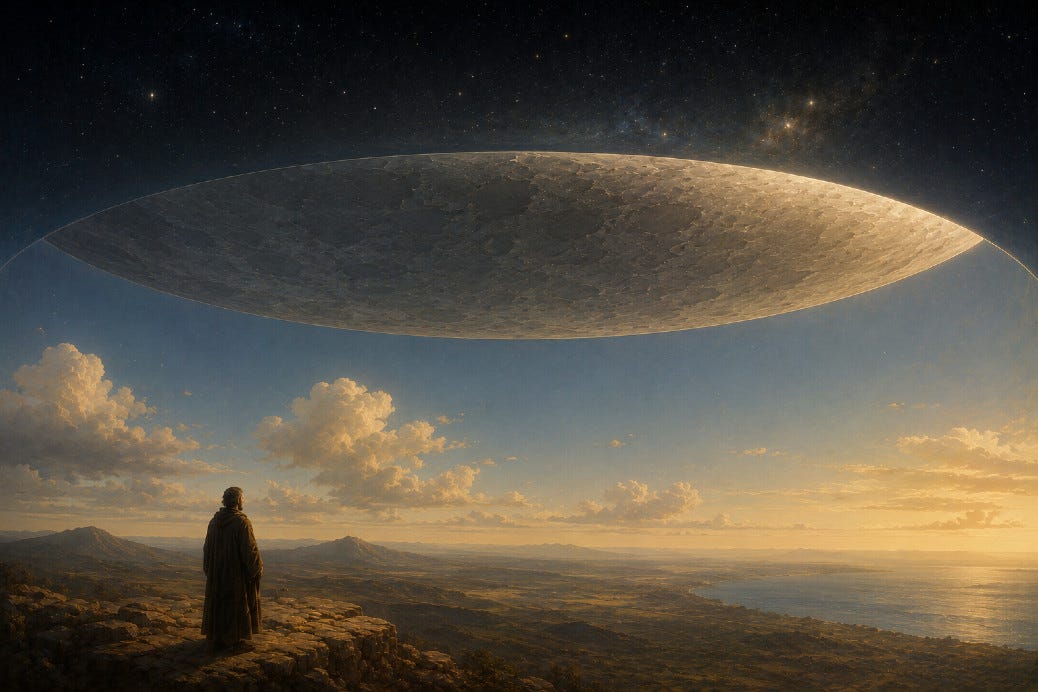
The third opinion is that the rakia mentioned here is the concave surface of the sphere of the moon. This surface serves as the divider between the lower waters—which are the perishable entities of the sublunar world—and the upper waters, namely the celestial bodies.
According to this view, since the term mayim (“waters”) includes all bodies, both celestial and terrestrial, and since there is a vast difference between the eternal heavenly bodies and the corruptible earthly bodies, God wished to establish a spatial separation between them. He therefore placed the noble celestial bodies above and the inferior perishable bodies below, creating the concave surface of the lunar sphere as the boundary between the two.
This is the meaning of: “And God made the firmament” (Genesis 1:7), namely, that He fashioned and ordered this surface as a properly arranged boundary separating the upper and lower realms.
This opinion is reported by Isaac Israeli in his work Yesod Olam (Book II, chapter 10).
At first glance, it may seem to receive support from the first witness, since birds fly upward toward the concave surface of the lunar sphere.
Nevertheless, this opinion is not acceptable.
For it is impossible that the creation of all the celestial bodies included under the name “heavens” should be attributed to the first day, while the creation of the concave surface of the lunar sphere should be attributed to the second day.
Were the celestial spheres created without enclosing surfaces? Without boundaries? Every body is created together with its surfaces. If the heavens already existed on the first day, then each sphere necessarily possessed both its convex and concave boundaries. How, then, can one imagine that the sphere of the moon was created on the first day but its concave surface was not created until the second?
I also find it extremely difficult to understand how Scripture could say: “Let there be a firmament,” and: “And God made the firmament,” if the firmament were merely a concave surface, which is an accident and has no independent existence of its own.
Moreover, the heavenly bodies were already distinct from the earthly bodies by nature, form, place, and position, since the heavenly bodies encompass while the earthly bodies are encompassed. What need was there, then, for this additional separation created by means of that surface?
I also find it extremely difficult to understand how Scripture could say: “Let there be a firmament,” and: “And God made the firmament,” if the firmament were merely a concave surface, which is an accident and has no independent existence of its own.
Furthermore, the witnesses strongly contradict this view.
The second witness teaches that the luminaries were placed: “in the firmament of heaven” (Genesis 1:14), yet they are certainly not situated merely in the concave surface of the lunar sphere.
The third witness comes from the vision of Ezekiel, who saw the firmament above the heads of the living creatures, not beneath them at the concave surface of the lunar sphere.
Likewise, the fifth witness from Pirkei de-Rabbi Eliezer states: “Which is the firmament that was created on the second day? It is the firmament above the heads of the living creatures.”
The fourth witness, from the words of King David, points in the same direction. Reason itself suggests that David would not attribute the proclamation of God’s glory and handiwork to the lowly surface of the lunar sphere when he says: “The firmament proclaims the work of His hands” (Psalm 19:2), or: “Praise Him in the firmament of His power” (Psalm 150:1).
Rather, such language properly refers to the celestial spheres themselves.
All the more so do the remaining witnesses from the words of the Sages oppose this interpretation, for it is impossible to explain them as referring to that surface in any reasonable manner. Their contradiction is obvious.
Nor does even the first witness truly support this view. For when Scripture says concerning the birds that they fly: “across the face of the firmament of heaven” (Genesis 1:20), even if penei (“face”) is understood as referring to a surface, rakia itself must still denote the sphere of the moon as a whole, not merely its surface.
This is evident.
(Parashat Bereshit — Genesis 1:6, A Boundary or a Created Reality? in the Commentary of Don Isaac Abarbanel)
Next section →

