


Previous section → A Boundary or a Created Reality?
The fourth opinion is that the term rakia (“firmament”) refers to the atmosphere.
According to this view, the air is divided into three regions, as explained in the Book of Meteorology1.
The first is the highest region, adjacent to the element of fire. Because it receives intense heat from it, it becomes hot and dry. Consequently, clouds and rain cannot form there, since there is no cold to condense the vapors. It is in this region, they say, that comets are generated.
The second is the middle region. It is not as hot as the upper region and is therefore moist. Since it is more distant from the source of heat, the vapors that rise into it cool and condense into water. Thus clouds and rain are formed there.
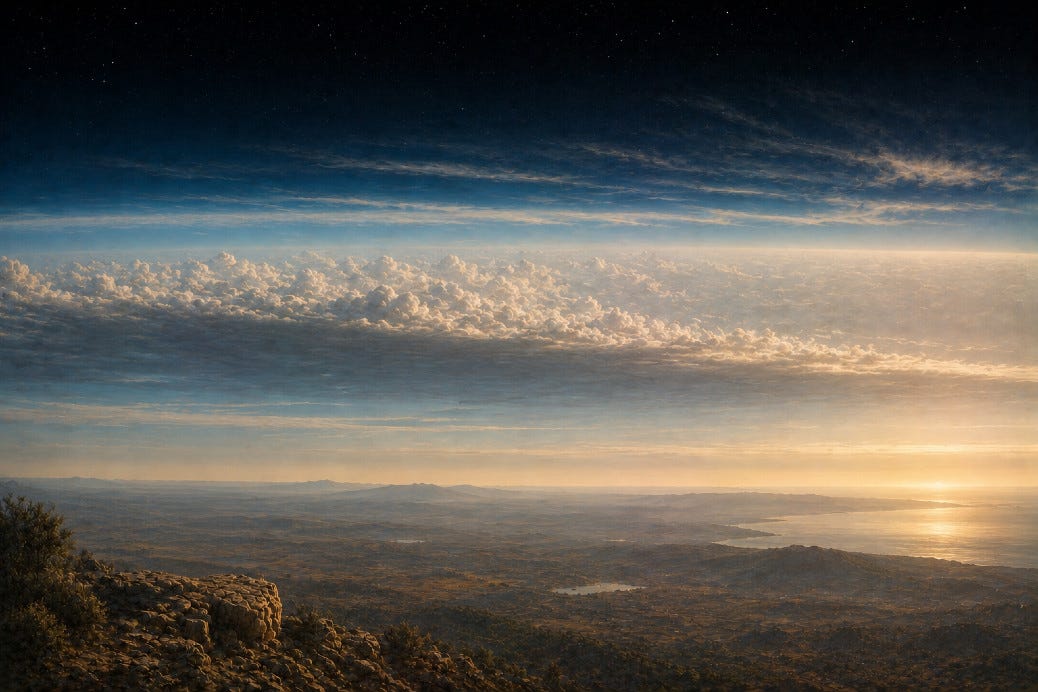
The third is the lowest region of the atmosphere, the one nearest to us. It is warm because of the reflection of the sun’s rays striking the element of earth. From this standpoint it is transparent like a sapphire.
According to this opinion, it is this lowest region of the atmosphere that Scripture calls the rakia. It separates “between waters and waters,” that is, between the lower elemental waters, which are actually water, and the waters that exist only potentially in the middle region of the atmosphere, where rain is formed. For this reason that middle region is also called “waters.”
The proponents of this opinion maintain that these are the “waters” of which the Sages spoke when they said that they were suspended by the divine command and that their fruits are the rains.
Thus: the lower waters are the elemental waters existing in actuality; the rakia is the lowest region of the atmosphere nearest to us; the waters above it are the middle region of the atmosphere, which is “water” only potentially because rain is generated there.
The uppermost region of the atmosphere, however, is neither water in actuality nor even potentially.
They further explain that this is the meaning of the saying of Rabbi Akiva (Babylonian Talmud): “When you reach the place of the pure marble stones, do not say, ‘Water! Water!’”2
That is, one must not say that the upper region of the atmosphere is water—neither potentially nor actually—for whoever does so speaks falsely. This, they say, is why the word “water” is repeated twice.
This opinion appears to receive support from the first witness concerning the birds, since birds fly in the atmosphere nearest to us. Accordingly Scripture says that they fly: “across the face of the firmament of heaven” (Genesis 1:20).
Likewise, they appeal to the tenth witness, according to which the Holy One, blessed be He, took all the waters of creation and placed half in the firmament and half in the Ocean. Half exist in actuality in the ocean, while the other half exist potentially in that atmospheric firmament.
Similarly, the statement that “the edges of the firmament are attached to the Ocean” can, in their view, apply only to the atmosphere called the rakia, not to a celestial sphere.
This was the opinion of Maimonides. After him, Samuel ibn Tibbon, Joseph ibn Kaspi, Shem Tov ibn Falaquera, Moses Narboni, Isaac Albalag, and others enthusiastically embraced this interpretation, accepting it as an established doctrine for themselves and their descendants.
Not so I.
Abraham ibn Ezra attempted to escape this difficulty by saying that Scripture merely attributes the luminaries to the firmament because they are seen through it. But this is truly a distortion and a deception.
In my judgment, this opinion speaks falsehood and utters deception.
I shall summon faithful witnesses against it from the Torah, the Prophets, the Writings, and the sayings of the Sages, for the hand of the witnesses must be the first against it.
The second witness is the verse concerning the luminaries. Scripture states that they were placed: “in the firmament of heaven” (Genesis 1:14).
They were not placed in the lower region of the atmosphere nearest to us.
Abraham ibn Ezra attempted to escape this difficulty by saying that Scripture merely attributes the luminaries to the firmament because they are seen through it.
But this is truly a distortion and a deception.
For Scripture explicitly declares: “Let there be lights in the firmament of heaven,” and: “God placed them in the firmament of heaven.”
These verses clearly indicate that the luminaries are located in the firmament itself, not merely seen by means of it.
An intervening medium, though it conveys what is perceived and is therefore closest to the senses, is not the place in which the visible object resides. Rather, it merely transmits what is seen.
Moreover, the luminaries are visible through every part of the atmosphere between heaven and earth. Why, then, should Scripture attribute them specifically to the lowest region alone?
(Parashat Bereshit — Genesis 1:6, The Firmament Beyond Meteorology in the Commentary of Don Isaac Abarbanel)
Next section →

