


Previous section → The True Structure of the Heavens
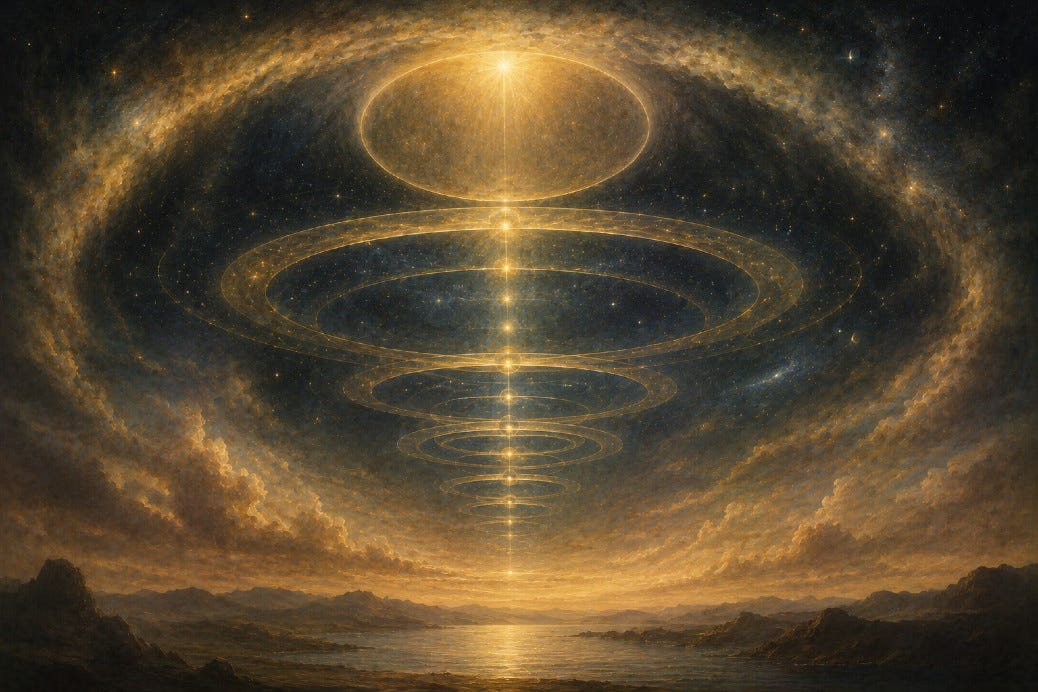
Thus, just as the earth created on the first day contained within itself the four elementary substances in their entirety, while the subsequent days brought forth the composite beings formed from those elements, so too the heavens created on the first day included both the separate intellects and a single immense celestial sphere, vast in size and thickness, which serves as the abode of the universe. On the second day, from that one great sphere—called shamayim (“heavens”)—God fashioned all the remaining concentric celestial spheres. It is these that Scripture here calls the rakia (“firmament”). Finally, on the fourth day, He placed the heavenly luminaries within them, as will be explained later.
It follows, therefore, that neither the remaining celestial spheres nor the heavenly luminaries were created on the first day. This accords with the opinion of Rabbi Eliezer ben Yaakov in the tractate Chagigah, which I cited earlier when discussing the fifth question of the first section. Moreover, we have received the tradition that the teachings of Rabbi Eliezer ben Yaakov are invariably kav ve-naki—few in number, yet exceptionally precise and reliable1.
It also follows that the firmament was not created out of absolute nothingness, but from something already created, for it was fashioned from the great sphere brought into being on the first day. For this reason Scripture says: “And God made the firmament,” rather than: “And God created the firmament.”2
I have already explained that the primary principles and origins created on the first day were brought into existence complete with the capacities required to produce the derivative realities that Scripture describes on the subsequent days.
The remaining celestial spheres were not created on the first day because that day was reserved exclusively for the creation of first principles out of absolute nothingness. It would not have been fitting for derivative beings—things produced from something already existing—to belong to the work of that day. Therefore, the Holy One, blessed be He, chose to create directly from nothing only the smallest number of beings necessary, so that everything else might subsequently be fashioned from them. Thus, He created only a single celestial sphere directly from nothing, in order that all the remaining celestial spheres might afterwards be made from it.
As for the lower world, however, He created the four elemental substances as first principles rather than only one, as He had done in the heavenly realm, because the eternal heavenly beings required only a single primordial beginning.
The lower world, however, because of the continual processes of generation and corruption that characterize it, required four elemental principles from which composite beings might be formed and into which they might ultimately dissolve.
Now the Holy One, blessed be He, saw fit to fashion the celestial spheres from that single sphere which He had first created, rather than leaving it forever as one undivided whole. This was for four reasons.
The first reason is that the separate intellects are many, and it was therefore fitting that the celestial spheres should likewise be many, for the multiplicity of movers requires a corresponding multiplicity of things moved.
The second reason is that, as the Philosopher taught, the outermost sphere attains its perfection through a single motion, whereas the remaining spheres cannot attain that same perfection except through many motions. Their multiplicity of motions corresponds to their greater remoteness from the First Mover. Thus, what the highest sphere achieves by a single motion because of its proximity to the First Mover, the lower spheres attain only through a plurality of motions.
Indeed, Aristotle himself wrote that the part of the sphere most perfectly united with its mover is the great circle that girds it midway between its poles, being equally distant from both.
Indeed, since the original celestial sphere was created so immense in size and thickness, its convex outer surface was necessarily closer and more directly joined to the separate intellect. For this reason, a single motion was sufficient for it to attain its perfection.
Its lower, concave regions, however, being farther removed from that first circumference and from the influence of the separate intellect, could not attain perfection through that same universal motion. For how could the concave portion of so vast a sphere, more distant from the separate intellect, attain perfection through the very same motion as its convex outer surface, which stands nearer to it?
Although the separate intellect occupies no place in the physical sense, its influence and motion must nevertheless be more immediately related to certain parts of the sphere than to others. Indeed, Aristotle himself wrote that the part of the sphere most perfectly united with its mover is the great circle that girds it midway between its poles, being equally distant from both.
Accordingly, Divine Wisdom ordained that the lower, concave portions of that original sphere should become distinct celestial spheres, each possessing its own motions. Through this multiplicity of motions, some would attain the same perfection reached by the higher convex regions through a single motion, while others, unable to attain that identical perfection, would achieve another perfection appropriate to their own nature.
(Parashat Bereshit — Genesis 1:8, Why One Heaven Became Many in the Commentary of Don Isaac Abarbanel)
Next section →

