


Previous section → Why One Heaven Became Many
The third reason concerns the heavenly luminaries and the stars.
Had they all been fixed within a single sphere, their influences would have been stronger than was fitting because of the immense power of the sphere carrying them1. The sun, for example, would have scorched the world with excessive heat, and the other stars likewise would have exercised their influences beyond their proper measure through the added power imparted to them by so mighty a sphere. In that case, either their effects would have exceeded the proper limits, or else, being situated in the highest and outermost sphere, they would have been so far removed from the inhabited world that their influence would have been weakened beyond what the recipients below required.
For this reason, His wisdom decreed that the luminaries should not be placed in the first sphere, whose daily motion encompasses all, but rather in smaller spheres situated beneath it, each within its own sphere. In this way, the influence of each luminary would be precisely measured, limited, and proportioned, neither exceeding nor falling short of what was appropriate.
The fourth reason concerns the affairs of the world below.
It has already been demonstrated by the philosophers that the diversity of motions among the celestial spheres gives rise to the various phenomena and changing conditions of the sublunary world2. Accordingly, the spheres move in different ways: some from east to west, others from west to east; some swiftly, others slowly; some carry a single star, while others bear many; some place their stars along the equator, others near the poles; and they differ in many other respects. All these distinctions exist in order to bring about the perfection of the world below, whether this was intended as the primary purpose or only as a secondary consequence—a question that does not concern us here3.
Had the original celestial sphere remained a single body moving with one uniform motion throughout, it could have produced only a single effect, whereas the lower world requires a rich diversity of influences.
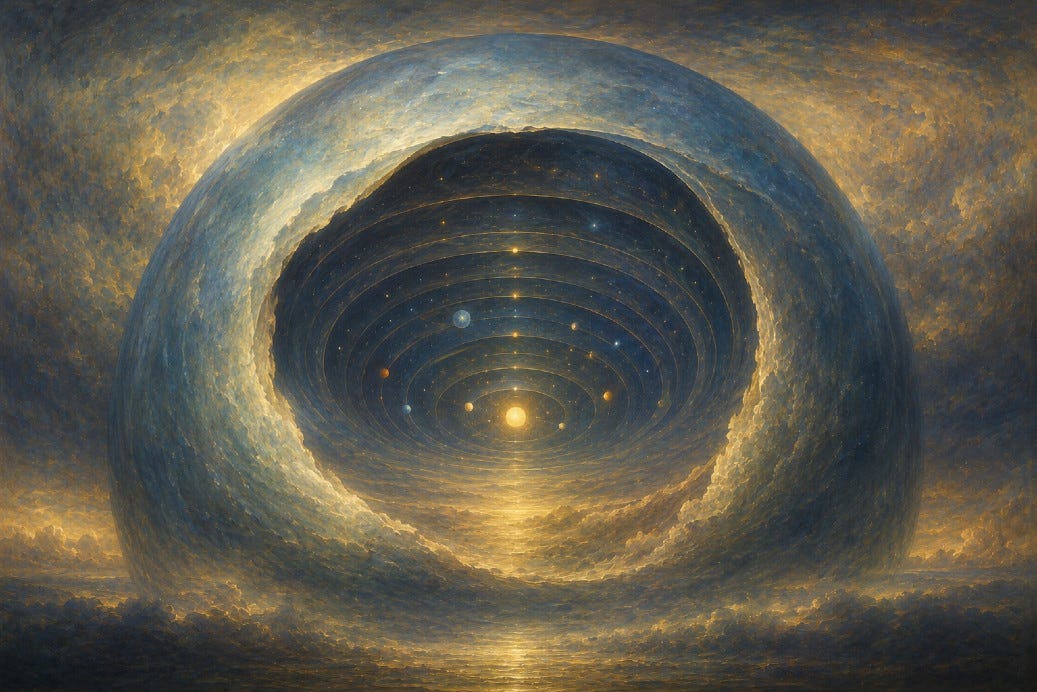
For all these reasons, the Supreme Wisdom saw fit to fashion, from the inner portion of that great celestial sphere created on the first day—which Scripture collectively called shamayim (”heavens”)—all the remaining concentric spheres enclosed within it. These Scripture designates by the name rakia (”firmament”), because they are stretched out and spread forth.
Thus, just as in the realm of the separate intellects, according to the doctrine of emanation, the Holy One, blessed be He, first brought forth the First Intelligence and only afterward the remaining intelligences; and just as in the material world He first created the four elements as its fundamental principles and afterward produced all the beings derived from them; so too in the realm of the celestial spheres He first created that one primordial sphere directly from nothing, and only afterward fashioned from it all the remaining spheres.
I have already explained the various analogies and figurative senses by which the heavenly sphere may be designated by the name waters. Thus, the verse means: Let a firmament come forth from within the water.
Now that all this has been established, we are in a position to explain the verses of this passage according to this principle4.
Scripture relates that, after the measure of light had been completed and its cessation—that is, the night—had come at the close of the first day, the First Cause, blessed be He, decreed: “Let there be a firmament in the midst of the water.” That is, let there come into being something stretched out and extended within the waters.
He called “water,” the great celestial sphere created on the first day. I have already explained the various analogies and figurative senses by which the heavenly sphere may be designated by the name waters. Thus, the verse means: Let a firmament come forth from within the water.
In other words, from the substance and thickness of that primordial celestial sphere, from its inner portion, there should come into being the rakia (”firmament”), that is, the collective name for all the concentric spheres enclosed within the first sphere that embraces and surrounds them all.
The meaning is that the firmament was not formed from the upper, convex surface of that sphere, but from its interior substance and thickness. This is the significance of the words: “in the midst of the water”—namely, that the firmament emerged from its innermost substance and thickness. As a result, what had previously been a single, continuous celestial body became differentiated into distinct parts.
This is the meaning of the words: “and let it be a separation between water and water.”
The verse does not refer to a separation between the upper waters and the lower elemental waters known to us. Rather, the very formation of the firmament brought about a distinction within the celestial sphere itself—between its upper and lower portions. Through this act of formation there arose a distinction of position and place between the outermost sphere, which encompasses all, and the concentric spheres that were fashioned within it.
This, then, is the true meaning of the firmament, and by it the first question is resolved. The second question, concerning the words: “and let it separate between the waters and the waters,” is likewise resolved.
(Parashat Bereshit — Genesis 1:8, The Firmament from Within the Waters in the Commentary of Don Isaac Abarbanel)
Next section →

