


Previous section → The Firmament from Within the Waters
Scripture then continues: “And God made the firmament,” in order to teach that the great primordial sphere did not possess within itself the power to produce, by its own natural capacity, the various celestial spheres lying beneath it with all their manifold differences and distinctions.
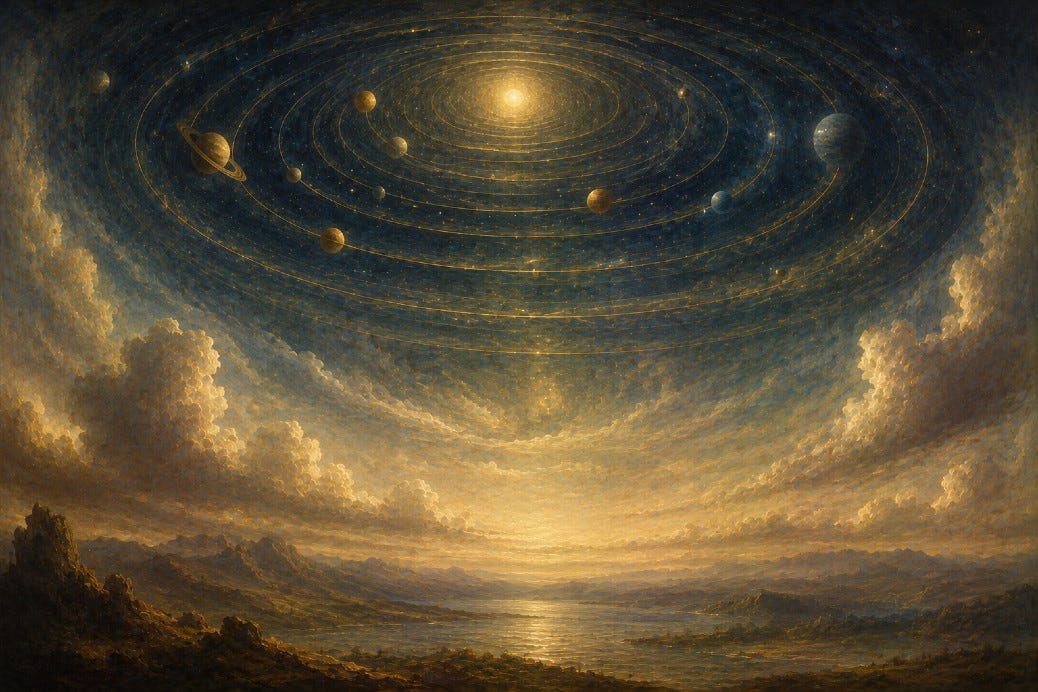
Had the firmament arisen from that first sphere solely by its own inherent nature and power, all the spheres derived from it would necessarily have been alike in their constitution and properties. The outermost sphere would not move from east to west in twenty-four hours while all the remaining spheres move from west to east. Nor would the eighth sphere complete its revolution in twenty-four thousand years, the sphere of Saturn in thirty years, that of Jupiter in twelve years, that of Mars in two years, that of the Sun in one complete year, that of Venus in twelve lunar months, that of Mercury in ten months, and that of the Moon in a single month1.
These differences, together with the many other distinctions among the spheres—their sizes, their centers, and the stars they contain—necessarily demonstrate, as Maimonides explains in Part II, Chapter 19 of the Guide for the Perplexed, that the celestial spheres exist through the will of a willing Creator and the intention of a purposeful Designer, blessed be He, rather than by natural necessity.
For this reason Scripture declares: “And God made the firmament.”
Its formation, with all its profound diversity, bears witness that “the hand of the Lord has done this.” From this you may also understand that whenever Scripture says: “And God made...” in the account of creation, it refers to the production of diverse forms from a single underlying material2.
Such was the case with the firmament. The Holy One, blessed be He, fashioned it not as a uniform body, identical in all its parts and spheres like the primordial celestial sphere from which it came, but with an astonishing variety of forms and properties.
It is for this reason that Scripture says: “And God made the firmament.”
Thus, the third question is resolved.
The explanation given here also clarifies the meaning of the other occurrences of the expression: “And God made...” each in its proper place.
This, moreover, is the meaning of the astonishment with which Ben Zoma “shook the world” over the words: “And God made the firmament.” He marveled that Scripture should speak of God’s making the firmament after having already declared, “Let there be a firmament,” for once the divine command had gone forth, its fulfillment was assured, as it is written: “By the word of the Lord the heavens were made”3 (Psalm 33:6)4.
Ben Zoma did not express the same astonishment over the words: “And God made” on the fourth and sixth days, because the diversity of the things fashioned on those days is evident and readily apparent. The case of the firmament is different. Ben Zoma, whose discourse was expansive and whose wisdom concerning the celestial spheres was profound, found in this expression an opportunity to reveal the remarkable differences among the heavenly bodies—their sizes, positions, motions, stars, centers, and all their other characteristics. It was in this sense that he “shook the world”: by displaying the breadth and grandeur of his knowledge of astronomy.
Nor does Scripture say: “And God made” on the first, third, or fifth days, because the works performed on those days did not involve this extraordinary diversity and differentiation. Scripture immediately explains what is meant by the making of the firmament when it continues: “And He separated between the waters beneath the firmament...”
God separated the waters above the firmament. This does not mean that He separated them from the lower waters. Rather, He established distinctions among the upper waters themselves by forming the various celestial spheres in the work of the firmament.
The One who performs this separation is none other than the Holy One, blessed be He.
The meaning is that, as part of His making of the firmament, He separated the waters beneath the firmament—that is, the elemental substances, which until then had remained mingled together without distinction. It is for this reason that Scripture refers to them collectively as “waters.” Through the motions of the celestial spheres, the Holy One, blessed be He, established the element of fire above, immediately beneath the concave surface of the lunar sphere; beneath it He placed the air, surrounding the waters; and the waters, in turn, surround the earth. Thus, through the motions of the celestial spheres, each element came to occupy its proper natural place.
Likewise, God separated the waters above the firmament. This does not mean that He separated them from the lower waters. Rather, He established distinctions among the upper waters themselves by forming the various celestial spheres in the work of the firmament5.
You now understand that the words: “and let it separate between the waters and the waters” in the first verse of this passage do not refer to the same separation described later in the words: “And He separated between the waters...”
The first passage speaks of the division within the original great celestial sphere itself—that is, the differentiation of its parts when the firmament was formed from it. The later passage, however, describes two further acts of separation carried out by God: first, the differentiation among the lower elemental substances themselves, and second, the differentiation among the upper celestial spheres themselves.
The correctness of this interpretation is further confirmed by the wording of the text. In the first verse Scripture says: “and let it separate between waters and waters,” whereas here it says: “And He separated between the waters beneath the firmament and the waters...” because these are two distinct acts of separation.
Thus the fourth question is resolved.
(Parashat Bereshit — Genesis 1:8, Creation by Wisdom, Not by Necessity in the Commentary of Don Isaac Abarbanel)
Next section →

