

Previous section → Creation by Wisdom, Not by Necessity
Scripture then says: “And it was so,” after the words: “And God made the firmament,”1 to teach that the ordering and separation established by the Holy One, blessed be He, among both the heavenly and earthly realms remained permanent and unchanged thereafter, even after the appearance of the dry land on the third day. This, indeed, is the constant meaning of the expression: “And it was so”— namely, permanence and enduring stability.
Thus the fifth question is resolved.
Finally, Scripture says: “And God called the firmament Heaven,”2 to teach that although the celestial spheres had been distinguished from the primordial sphere and thereby acquired properties different from it—so that one might have thought it inappropriate to call them shamayim (”heavens”), like that original great sphere—the Holy One, blessed be He, nevertheless gave the firmament the name shamayim.
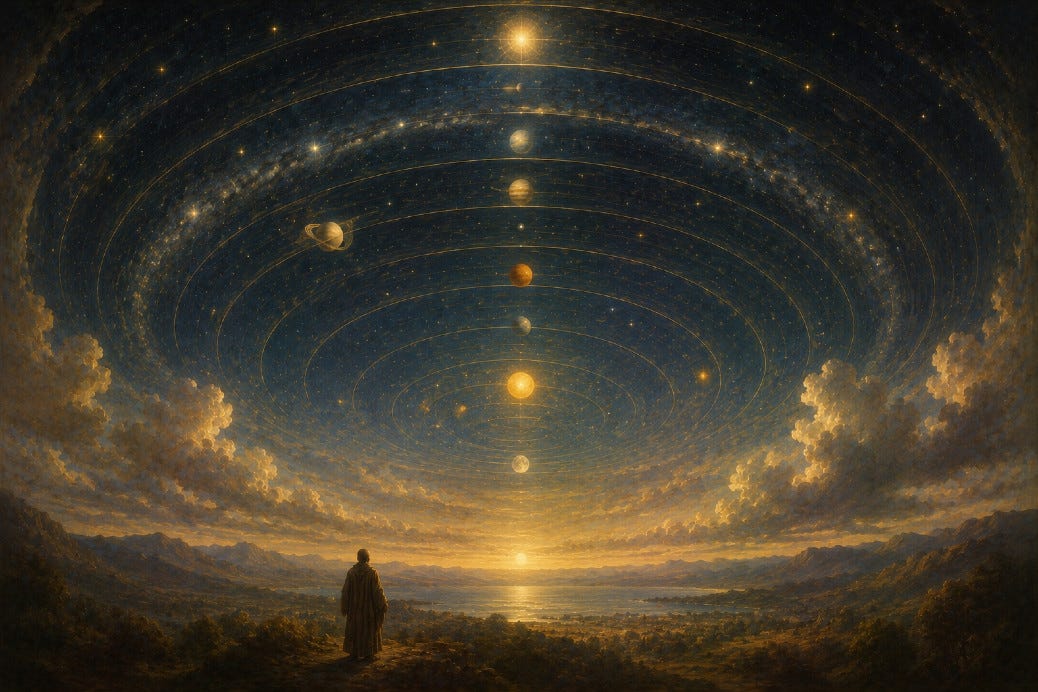
The meaning of this naming is that all the celestial spheres constitute a single unified system together with the all-encompassing sphere. Despite all their differences, they are united as one organism, whose head is the first and highest sphere and whose extremity is the sphere of the moon. They are also united by the daily motion, for all the spheres participate in that motion together with the first sphere3.
For this reason He called the firmament shamayim, the very name of the first sphere from which all the others emerged. They bear the name of their progenitor, just as children inherit the name of their father.
This, then, is the true meaning of God’s naming the firmament. It was not, as Maimonides maintained, merely to distinguish it from another object bearing the same name. Rather, it serves to reveal the nature of the celestial spheres and their unity with the first sphere.
Thus the sixth question is resolved.
Moreover, the celestial sphere exists for the sake of the star it carries, for the star is its most excellent component. Yet the heavenly luminaries had not yet been placed in the firmament, since this would not occur until the fourth day.
For this reason, the expression: “that it was good” is absent from the second day. Although the celestial spheres were fashioned on that day, they were still without their luminaries and stars.
There is also another reason. The separation of the elements was not yet complete until the third day, when the waters were gathered together and the dry land appeared.
Thus the seventh question is resolved.
They understood the words, “And God separated the waters beneath the firmament,” much as I have explained them: namely, that the Holy One, blessed be He, separated the elements from one another so that each might become established in its own proper qualities and thereby exercise its natural power upon the others.
Furthermore, since two distinct separations took place on the second day—the separation among the heavenly realms and the separation among the earthly elements, as I have explained—Scripture says: “And there was evening and there was morning, a second day.” Evening corresponds to the ordering of the lower realm, while morning corresponds to the ordering of the heavenly realm.
As for the statement of our Sages that on the second day were created “our light,” “the light of Gehinnom,” and discord, their teaching also possesses a sound foundation.
They understood the words, “And God separated the waters beneath the firmament,” much as I have explained them: namely, that the Holy One, blessed be He, separated the elements from one another so that each might become established in its own proper qualities and thereby exercise its natural power upon the others. While they remained mingled together, none possessed its full strength.
In this sense, discord came into existence, for the separated elements now stood in opposition to one another, each asserting its own nature against the others.
Likewise, once the element of fire had been separated and established in its own place, it became actual light. This, according to the Sages, is the meaning of “our light.” So too with “the light of Gehinnom,” which they understood as a subtle, spiritual fire that punishes souls, as Ramban explains in Sha’ar Ha-Gemul.
It is also possible that they called it “Gehinnom” because it signifies the corruption and dissolution of composite bodies resulting from the struggle among the elements themselves4.
Finally, because the separation of the waters from the earth was not completed until the third day, the Sages were likewise correct in saying that the work of the waters was not completed on the second day but reached its completion only on the third.
Accordingly, none of their words falls to the ground.
(Parashat Bereshit — Genesis 1:8, The Unity Hidden Within Diversity in the Commentary of Don Isaac Abarbanel)
Next section →

Genesis 1:7.
Genesis 1:8.
According to the Ptolemaic cosmology adopted by Abarbanel, each celestial sphere possesses its own proper motion (accounting for the distinct movements of the planets), while all the spheres also participate in the common daily rotation of the outermost sphere from east to west. This shared motion expresses the unity of the heavenly order despite the diversity of the individual spheres.
In Aristotelian natural philosophy, all physical objects are “composite bodies” (murkavim), formed from the four elements: earth, water, air, and fire. Because these elements naturally oppose one another—for example, fire tends upward while earth tends downward—their continual interaction eventually causes composite things to decay and perish. Abarbanel therefore suggests that the Sages may have associated this process of corruption and dissolution with “Gehinnom,” using the term metaphorically to describe the destructive consequences of the elements struggling against one another.