

Previous section → The Unity Hidden Within Diversity
After explaining this passage and answering its questions, it remains for me to demonstrate and confirm that my interpretation of the firmament accords with the testimony of the witnesses—the Torah, the Prophets, the Writings, and the sayings of our Sages—who have spoken concerning it. Given the importance of this subject, and considering how many of the later sages of our nation have stumbled over it, it would be inappropriate to pass over the matter lightly, for this is one of the fundamental principles of the account of Creation1.
First, the firmament mentioned in connection with the birds—“Let fowl fly above the earth, across the face of the firmament of heaven”2 (Genesis 1:20)—does not contradict what I have explained. For birds fly toward the sphere of the moon, which is one of the celestial spheres included under the collective name of the firmament.
Indeed, Scripture’s wording is particularly precise. It says: “across the face of the firmament of heaven,” not simply “in the firmament of heaven,” because fowls do not reach the concave surface of the lunar sphere itself. Rather, they fly opposite its visible face—that is, toward the surface turned toward the earth, which is truly the “face” of the firmament.
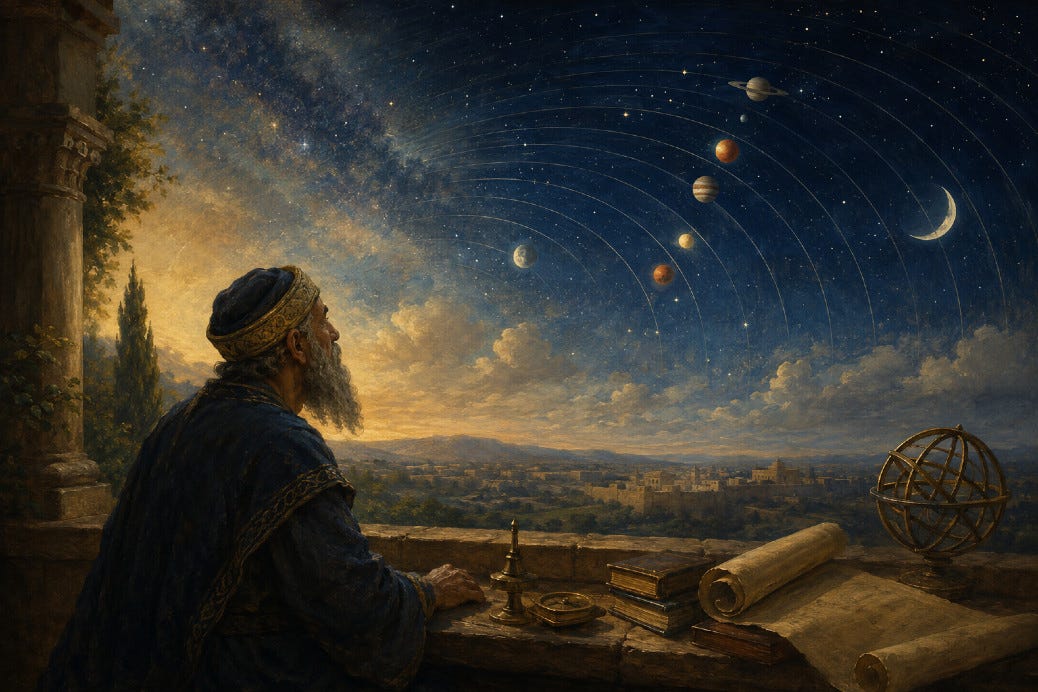
Likewise, concerning the luminaries, Scripture says that they were placed “in the firmament of heaven”3 (Genesis 1:14), because they are situated within those celestial spheres collectively called the firmament. Notice that it says “in the firmament of heaven,” not merely “in heaven,” because in this context the name shamayim (“heaven”) refers specifically to the first and all-encompassing sphere, whereas the expression “firmament of heaven” designates the concentric spheres enclosed within that first sphere.
Turning now to the testimony of the Prophets, the firmament mentioned in Ezekiel’s vision is the eighth sphere, the sphere of the fixed stars. It is concerning this sphere that the prophet says: “And above the heads of the living creatures was the likeness of a firmament...”4 (Ezekiel 1:22). According to the opinion of the author of the Guide, the “living creatures” in that passage represent the seven spheres of the wandering planets. The firmament above them is therefore the eighth sphere. Since the Torah applies the name rakia (“firmament”) to all the celestial spheres, it is fitting that the eighth sphere—the noblest of them all, spread out above the others—should likewise bear that name.
Such an explanation cannot possibly be accepted by the author of the Guide himself, nor would he affirm it. For he explicitly explains in the chapters of the second part that, according to Aristotle, there are only eight celestial spheres, or, according to Ptolemy, nine—but certainly no tenth sphere whatsoever.
This interpretation is confirmed by the continuation of the vision: “And above the firmament that was over their heads was the likeness of a throne, in appearance like a sapphire stone; and upon the likeness of the throne was the likeness, in appearance, of a man above it” (Ezekiel 1:26). That throne can only be the highest sphere—the exalted and lofty throne. Concerning its mover, the prophet says that he saw above it “the likeness... of a man.” It necessarily follows that the firmament is the eighth sphere lying beneath it.
Indeed, according to Maimonides’ interpretation of Ezekiel’s vision of the Chariot, this explanation is unavoidable5. For if you were to interpret the firmament as the first sphere itself, what then would become of the throne situated above it? Shall we say that it is the sphere of the Active Intellect, which the Kabbalists called Shmei Ha-Hatzlachah6, as some commentators on the Guide have imagined?
Such an explanation cannot possibly be accepted by the author of the Guide himself, nor would he affirm it. For he explicitly explains in the chapters of the second part that, according to Aristotle, there are only eight celestial spheres, or, according to Ptolemy, nine—but certainly no tenth sphere whatsoever.
To show that the celestial spheres are indeed the firmament, Rabbi Eliezer the Great said: “Which is the firmament that was created on the second day? It is the firmament above the heads of the living creatures,”7 thereby referring to the eighth sphere, which is the first and most exalted part of the firmament.
The testimony of the Writings likewise supports this interpretation. David, of blessed memory, declared: The heavens declare the glory of God, and the firmament proclaims the work of His hands (Psalms 19:2). By “the heavens” he intended the first sphere, which encompasses all the others and proclaims the glory of God through its daily motion. By “the firmament,” however, he meant the collective body of the celestial spheres contained within it, which proclaim the work of the Holy One, blessed be He. The expression “the work of His hands” is particularly appropriate, since Scripture itself says: And God made the firmament (Genesis 1:7). David further makes it clear that the firmament refers to the celestial spheres when he continues: Their line has gone out through all the earth, and their words to the end of the world; in them He has set a tent for the sun (Psalms 19:5). The sun, of course, is situated within the celestial spheres.
(Parashat Bereshit — Genesis 1:8, The Testimony of Scripture in the Commentary of Don Isaac Abarbanel)
Next section →

