

Previous section → Heavens, Waters, and the Firmament
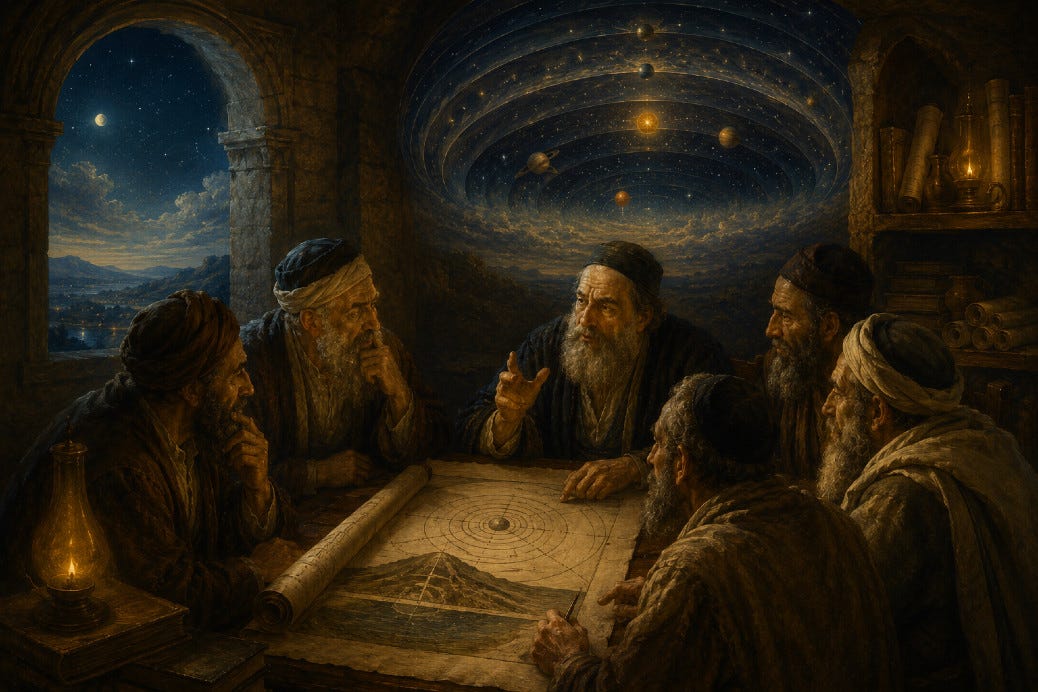
Thus, all the Rabbis and the other Sages named as holding the first opinion upheld and accepted the position I have presented concerning the firmament: namely, that it comprises all the celestial spheres contained within the encompassing sphere. This is what they meant when they said that the middle drop congealed. They meant that the firmament was not the first sphere, for that had already been created on the first day. Rather, what congealed was the middle drop—that is, the corporeal substance within it—which thereby came to occupy the intermediate region between the first sphere and the elements. From this middle drop were formed the lower heavens and the uppermost heavens above them, extending as far as the eighth sphere. This, in my judgment, is the true interpretation.
Rav, however, held the opinion cited by Rashi, Ramban, Ralbag, and Rabbenu Nissim: that the firmament was the first sphere itself, together with all the other spheres contained within it. All of them were created together on the first day, but they were still fluid and their formation was incomplete; on the second day they solidified and their existence was firmly established. Since the words “Let there be a firmament” would appear to contradict this view, Rav interpreted them to mean: Let the firmament become firm.
Rabbi Yehudah and Rabbi Simon, by contrast, adopted the first opinion: that the firmament was the uppermost sphere alone, as maintained by the sages of the nations. Accordingly, they said that the firmament was made into a sheet. Their meaning was that the first and encompassing sphere was initially created as a sheet-like surface and was not yet spherical. On the second day it was spread out and became the firmament, for its substance was refined in such a way that it acquired a greater spherical extension. This is comparable to the expression, “They hammered out sheets of gold”(Exodus 39:3): the sheets already existed, but they were beaten out so as to spread them and increase their dimensions.
You can therefore see clearly that all the opinions mentioned concerning the firmament, insofar as they regard it as belonging to the class of celestial bodies, are encompassed within this teaching of the Sages.
Rabbi Chananiah, however, followed another approach—the one mentioned, though without attribution to him, by the author of Yesod Olam—namely, that the firmament was the concave surface of the sphere of the moon. This is the meaning of his statement that fire came forth from above and licked the surface of the firmament. The fire alludes to the divine decree, for He is a consuming fire1: it came forth from above and acted upon, or licked, the surface of the firmament—that is, the surface of the lowest sphere, which separates the upper realms from the lower. He supported this opinion with the verse, “By His breath He made the heavens a tent” (Job 26:13), for this makes clear that the fire said to have come forth from above is an allusion to His breath and His will, blessed be He, through which He beautified the surface of the heavens.
You can therefore see clearly that all the opinions mentioned concerning the firmament, insofar as they regard it as belonging to the class of celestial bodies, are encompassed within this teaching of the Sages. Yet since the first opinion is attributed to all the Rabbis, as well as to the other distinguished Sages who were the leaders of Israel, we know that this is undoubtedly the true opinion.
The Sages likewise said that the distance from the earth to the firmament is a journey of five hundred years, and that the same distance separates the firmament from the upper waters; that the thickness of the earth is equal to the thickness of the firmament; and other similar statements2. In all these teachings they intended precisely what I have explained: the depth of the world of the elements and of the composite bodies formed from them corresponds to the distance and measure extending from the earth to the firmament, which is the sphere of the moon. The same applies from one firmament to another, for each of the encompassing celestial spheres may be called a firmament.
So too, when they interpreted “Let there be a firmament in the midst of the waters” as meaning between one body of water and another, their intention was that the firmament stood between the lower waters, which are among the elements, and the first encompassing sphere, which is the upper waters. Likewise, Rabbi Tanchuma’s statement that the upper waters are suspended by the divine word was intended to teach that the elemental waters found here below are heavy and are supported and sustained by the earth beneath them. This is not so of the upper waters. Scripture does not say that they are upon the firmament, as though their weight required the firmament to support them. Rather, since it says that they are above the firmament, we learn that they stand by themselves, bearing and containing everything else. This is the uppermost sphere, which constitutes the place of the world, and its existence depends solely upon the divine word. Rashi likewise explained the matter in this way in the first chapter of Ta’anit3.
(Parashat Bereshit — Genesis 1:8, The Sages and the Structure of the Heavens in the Commentary of Don Isaac Abarbanel)
Next section →

