


Previous section → The Sages and the Structure of the Heavens
They further said that the Holy One, blessed be He, took all the waters of Creation and placed half of them in the firmament and half in the Ocean. They also said that the edges of the firmament are joined to the edges of the Ocean. Their intention was not what Ibn Ezra and those who followed him supposed. Rather, they sought to teach that rain has two causes. The first is the efficient cause: the celestial bodies, which through their motions bring about rain. The second is the material cause: the vapors that rise from the seas, rivers, and other bodies containing moisture. Thus, when they said that He placed half of the waters in the firmament, they meant that the firmament constitutes one of the causes of rain—namely, its efficient cause—while the other half was placed in the Ocean, which constitutes its material cause. And to express the relationship between the agent and that upon which it acts, they said that the edges of the firmament are joined to the Ocean.
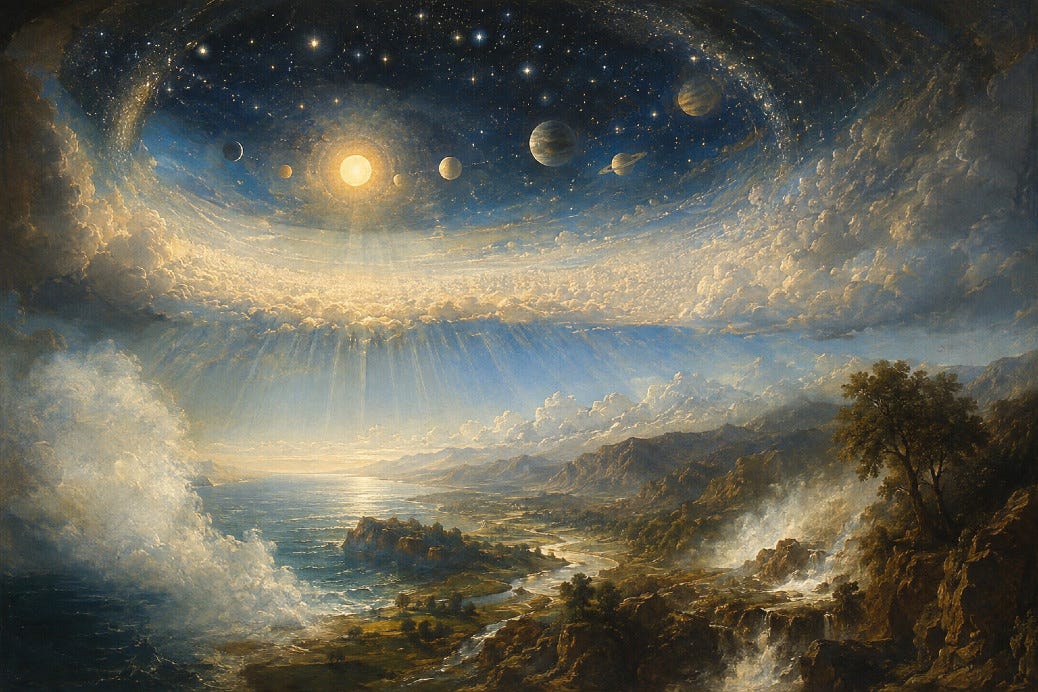
This is likewise the meaning of what they said in Midrash Tehillim: that the upper waters are male and the lower waters female; that the males say to the females, Receive us; and that they are the channels of the Holy One, blessed be He, as it is said, “Deep calls to deep to the sound of Your water channels”1 (Psalms 42:8). The same idea underlies their statement in Bereshit Rabbah that the firmament resembles a pool, with a dome above the pool2. The dome alludes to the sphere of the fixed stars, while the firmament consists of the celestial spheres contained within it. When they said that from beneath the pool a drop of moisture trickles down, their meaning was that, according to the configurations of the wandering stars—that is, the planets—which constitute the firmament, together with the dome above them, namely the eighth sphere, rain is brought about, and water is caused to descend upon the earth.
All of this is encompassed by two verses. The first is, “and absorbs water from the rains of heaven”3 (Deuteronomy 11:11), referring to the efficient cause of rain, namely the celestial bodies through their motions. The second is, “A mist rose from the earth and watered [the whole surface of the ground]” (Genesis 2:6), referring to its material cause. The Sages likewise explained this matter in the first chapter of tractate Ta’anit4.
They further said in Bereshit Rabbah: The lower waters were separated from the upper waters only through weeping, as it is said, “He binds the streams from weeping”5 (Job 28:11). Rabbi Tanchuma derived this from the verse, “At the sound of His giving forth a multitude of waters in the heavens”6 (Jeremiah 10:13); and sound signifies nothing other than weeping, as it is said, “A voice is heard on high, lamentation and bitter weeping”7 (Jeremiah 31:14)8.
You already know that this was the opinion of the early astronomers, who maintained that the spheres of Venus and Mercury were above the sun. The sun would therefore occupy the second sphere, as the author of the Guide explained in Part II, chapter 9.
By weeping they alluded to the corruption that overtakes the lower beings. It is as though they were saying that the celestial bodies, which the Torah calls the upper waters, are distinguished from the lower generated bodies not merely by a difference of location, but by weeping, which alludes to corruption: the lower beings are subject to corruption, whereas the upper beings remain permanent and enduring. This is the most essential distinction between them.
They further said there: Where are the sun and the moon situated? In the second firmament, as it is said, “And God placed them in the firmament of the heavens”9 (Genesis 1:17). For had they been placed in the first firmament, no creature could have endured the heat of the day10. Their opinion was that the sun and the moon occupied a single sphere, namely the second sphere. They did not hold that the sun occupied a middle position among the planetary spheres, but rather that it was in the second sphere and that the moon was there together with it; hence the relationship they perceived between their motions. They said that the Holy One, blessed be He, did not wish to place them in the first sphere—that is, the sphere nearest to us—because, had He done so, no creature could have endured the heat of the sun. On account of its proximity, its heating effect would have been so intense as to consume everything by fire.
You already know that this was the opinion of the early astronomers, who maintained that the spheres of Venus and Mercury were above the sun. The sun would therefore occupy the second sphere, as the author of the Guide explained in Part II, chapter 911. For this reason they likewise said in tractate Chagigah: “Rav Yehudah said, There are two firmaments, as it is said, Behold, to the Lord your God belong the heavens and the heavens of heavens (Deuteronomy 10:14). Reish Lakish, however, said: There are seven firmaments.”12
You have already seen the words of the author of the Guide in the chapter just mentioned and in Part I, chapter 70: those who count seven firmaments refer only to the seven wandering stars, that is, the seven planets. Those who count two took account of the first sphere, which contains no star at all, and called it a firmament because it is spread out and extended over them; while all the depicted spheres that contain stars they collectively called a single firmament. They based this upon the verse, “Behold, to the Lord your God belong the heavens and the heavens of heavens”, calling the first sphere the heavens, just as the Torah calls it in its opening verse, and calling the other enclosed spheres the heavens of heavens—that is, the heavens contained within the heavens.
It appears more correct to me, however, to interpret the two firmaments differently: one is the sphere of the fixed stars, which is the heavens of heavens, and the other comprises the seven wandering stars. For the first sphere, which encompasses everything, should not be called a firmament.
(Parashat Bereshit — Genesis 1:8, The Permanent and the Perishable in the Commentary of Don Isaac Abarbanel)
Next section →

