

Previous section → The Permanent and the Perishable
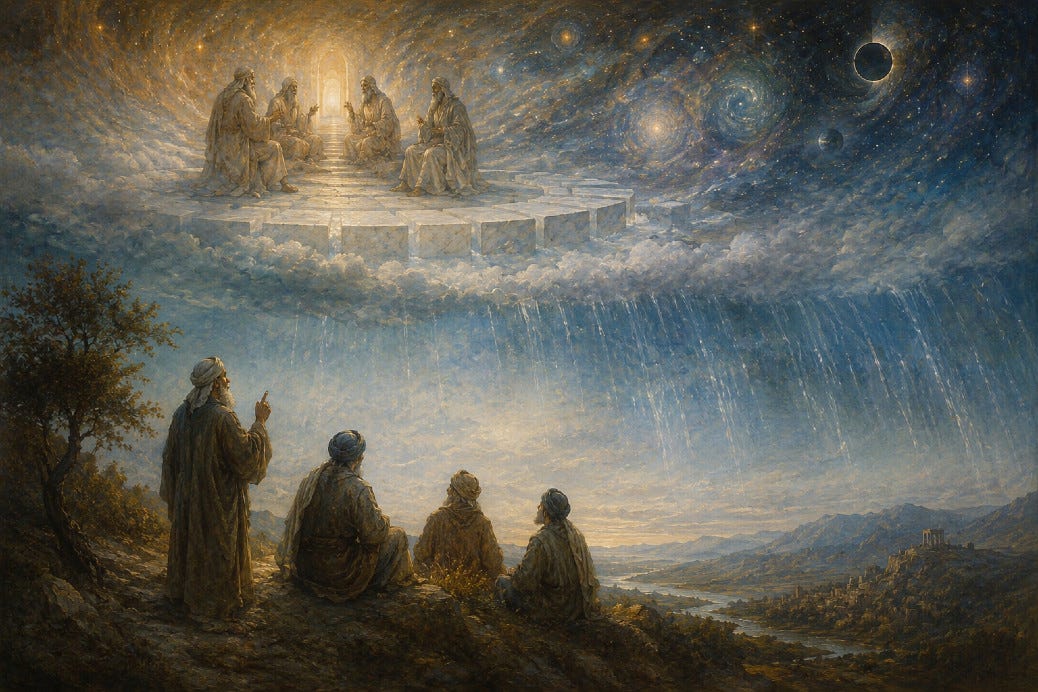
It remains for us to explain those difficult teachings found in tractate Chagigah. The Rabbis taught: Four entered the Pardes: Ben Azzai, Ben Zoma, Acher, and Rabbi Akiva. Rabbi Akiva said to them: When you reach the stones of pure marble, do not say, Water, water, for it is written, “He who speaks falsehood shall not be established before My eyes”1 (Psalms 101:7)2.
The Rabbis further taught: It once happened that Rabbi Yehoshua ben Chananiah was standing on a step of the Temple Mount. Ben Zoma saw him but did not rise before him. Rabbi Yehoshua said to him: From where and to where, Ben Zoma? He replied: I was contemplating the space between the upper waters and the lower waters, and there is no more than three fingerbreadths between them, as it is said, “And the spirit of God hovered over the surface of the waters”3 (Genesis 1:2)—like a dove hovering over its young, touching yet not touching. Rabbi Yehoshua said to his disciples: Ben Zoma is still outside. For consider: “And the spirit of God hovered over the surface of the waters” was written concerning the first day, whereas the separation took place on the second day, as it is written, “And let it separate between water and water”4 (Genesis 1:6). And how great is the distance between them? Rabbi Acha bar Yaakov said: A hairbreadth. The Rabbis said: Like the space between the boards of a bridge. Mar Zutra—or, according to another version, Rav Ashi—said: Like two garments spread one over the other; and some say, like two cups placed one upon the other. Rashi explained that the comparison to the boards of a bridge means that when boards are laid alongside one another, it is impossible for there not to be a slight space between them. The same applies to the garments and to the overturned cups placed one upon another5.
I am well aware of how the author of the Guide and the other later commentators explained these teachings, interpreting them as referring to the different regions of the air, the formation of rain, and the difficulties that follow from this interpretation6. But the true meaning intended by those holy Sages is as I shall now explain. They were investigating and seeking to determine the nature of the waters above the firmament. Since it was obvious to them that the firmament was a celestial body, or a number of celestial bodies, they were confronted with the question: What, then, are the waters above it? Some of them thought that these upper waters alluded to the separate intellects that move the celestial spheres, and that this was why they were said to be above the firmament.
Those among them, however, who attained the truth of the matter and penetrated more deeply into the mysteries of the Account of Creation recognized that this was not so. The expression upper waters was not applied to the separate forms, for in the language of the Torah and the Prophets these are described as fire or spirit, but never as water. The term water is applied to celestial corporeal substance, not to the separate forms.
Since Ben Zoma fell into this error, when Rabbi Yehoshua asked him what had occupied his solitary contemplation, he replied: “I was contemplating, and there are only three fingerbreadths between the upper waters and the lower waters.”
This is the meaning of Rabbi Akiva’s statement upon entering the Pardes of intellectual contemplation—that is, when he entered into the investigation of the Account of Creation. He told his companions: “When you reach the stones of pure marble, do not say, Water, water.” He called the separate forms stones because they are the principles and foundations of the world, just as stones are the foundations of a building. It is in this sense that Scripture says, “From there is the Shepherd, the Stone of Israel”7 (Genesis 49:24), calling Him a stone because He is the foundation of the whole structure8.
Rabbi Akiva called them pure marble [shayish tahor] because shayish is related to yesh, being, a term denoting existence. Marble is thus so called because it is a stone that endures and remains for many days. It is as though he were saying: When, in your contemplation and investigation, you reach the separate forms, which constitute the pure and exalted principles of existence, do not say, Water, water—that is, do not suppose that these are the waters mentioned in the Account of Creation, whether the lower waters or the upper waters. For those exalted forms are incorporeal; how, then, could the Torah apply to them the term water, whether upper or lower?
Since Ben Zoma fell into this error, when Rabbi Yehoshua asked him what had occupied his solitary contemplation, he replied: “I was contemplating, and there are only three fingerbreadths between the upper waters and the lower waters.” His meaning was that the waters below the firmament—which, in his view, comprised all corporeal beings—were distinguished from the waters above it—which, in his view, were the intellects separate from matter—only by the three dimensions inherent in every body: length, breadth, and depth. The lower waters thus comprised all corporeal beings, whether eternal or subject to generation and corruption, since all are encompassed by these three dimensions insofar as they are bodies. The upper waters, by contrast, were the separate beings, in which there is no corporeality whatsoever and consequently none of the three dimensions of body.
That this was indeed his intention is evident from the proof he brought from the verse, “And the spirit of God hovered over the surface of the waters” (Genesis 1:2). In his understanding, this indicated that the upper waters were the spirit of God: those spiritual forms constituted the spirit of God hovering over the surface of the waters—that is, the movers of the corporeal beings, which were the lower waters and included the celestial bodies themselves. He explained this hovering by the image of a dove that touches yet does not touch. For since these beings are spirits and forms rather than corporeal entities, they do not physically touch or come into contact with one another, since the notions of physical contact and touching cannot properly be applied to that which is incorporeal.
(Parashat Bereshit — Genesis 1:8, The Mystery of the Upper Waters in the Commentary of Don Isaac Abarbanel)
Next section →

