

Previous section → The Mystery of the Upper Waters
Since Ben Zoma sought to explain the distinction between the upper and lower waters from the verse, “And the spirit of God hovered over the surface of the waters”—taking the upper waters to be spirit and separate intellect, and the lower waters to be body—Rabbi Yehoshua said to his disciples: Ben Zoma is still outside. In other words, he had not yet entered the Pardes of wisdom and truth, but remained outside it. For the upper waters do not refer to the separate forms, but to the celestial bodies. Moreover, the verse Ben Zoma cited as proof cannot refer to the separation at all. On the contrary, on the first day the upper and lower waters had not yet been separated; the separation between them took place on the second day. This itself demonstrates that the words “And the spirit of God hovered over the surface of the waters” cannot refer to the distinction proposed by Ben Zoma.
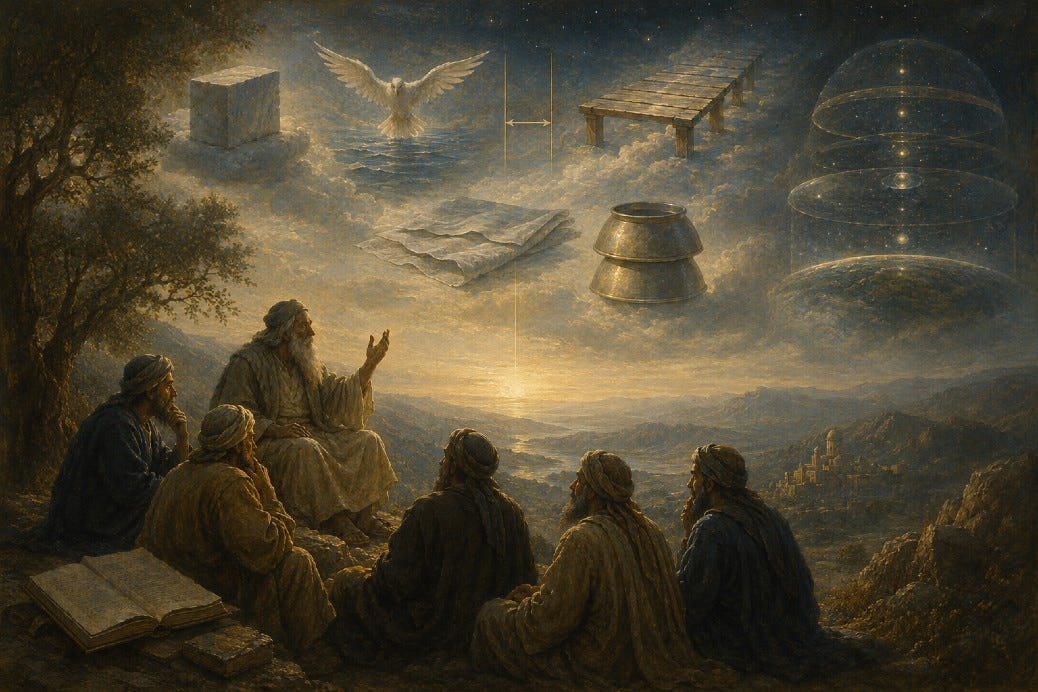
Rabbi Acha then asked: And how much? That is, how great was the separation between the upper waters—which, according to Rabbi Yehoshua, were the celestial bodies—and the lower waters, which in his view were the lower elements? Four opinions were given in response, corresponding to four groups of Sages. The first said: A hairbreadth; the second: like the boards of a bridge; the third: like two garments spread one over the other; and the fourth: like two cups placed one upon the other.
It appears to me that Rabbi Acha and the Rabbis, who held the first two opinions, understood the distinction between the upper and lower waters as a spatial distinction. Rabbi Acha held that the innermost surface of the sphere of the moon was what separated them. This is what he intended by saying, a hairbreadth. Since a surface has no thickness, he described it figuratively as being only a hairbreadth.
The Rabbis, however, held that it was improper to attribute this separation to a surface, since a surface is merely an accident1; rather, it should be attributed to the entire sphere of the moon, the lowest of the celestial spheres, which separates the celestial bodies from the elements. This is why they compared it to the boards of a bridge. Their comparison was not intended in the sense understood by Rashi. Rather, a bridge-board is itself a distinct corporeal object, with air beneath it and, beneath the air, the water of the river. In the same way, the sphere of the moon is a corporeal entity in its own right; beneath it lies the element of fire, then the air, and beneath them the element of water.
Mar Zutra and Rav Ashi, however, held that the distinction between the upper and lower waters was not spatial, but rather one of nature and form. It should therefore be attributed neither to a surface nor to the sphere of the moon alone. Rather, the upper waters—the celestial spheres in their entirety, together with their nature and form—are distinct from the lower waters. This is the meaning of the comparison to two boards spread one above the other: the two boards allude to the two firmaments, according to the opinion that there are two firmaments. They therefore compared them to two boards of a bridge, one above the other and separate from one another, just as one firmament is distinct from the firmament beneath it.
Since all these opinions employed comparisons involving the boards of a bridge, on account of the air and water beneath them, the final opinion considered this comparison inappropriate to the celestial bodies, because boards are straight, whereas celestial bodies are spherical. It therefore compared them to overturned cups—that is, rounded vessels fitting one within another—for in this respect they resemble the arrangement of the celestial spheres.
When the accounts of the first and absolute Creation are interpreted as referring merely to processes of natural generation, through forced and contrived explanations, belief in the creation of the universe as a whole is inevitably weakened, and truth is cast to the ground.
It has thus been demonstrated that the words of Rabbi Akiva and those of Rabbi Yehoshua accord in every respect with what I have explained. All these Sages were investigating the upper realms; they were not discussing the element of air, for such a subject would hardly have constituted the mystery of the Pardes. This is how the words of those holy Sages concerning the firmament and the waters above it ought to be understood—not as they have been interpreted by those would-be sophisticates among our people, who have made so fundamental a passage in the Account of Creation depend upon a simple and feeble inquiry into the qualities of the air and the formation of rain2, matters that even the lesser philosophers were able to grasp through superficial investigation.
There can be no doubt that this has caused many to stumble in their belief in creation. For when the accounts of the first and absolute Creation are interpreted as referring merely to processes of natural generation, through forced and contrived explanations, belief in the creation of the universe as a whole is inevitably weakened, and truth is cast to the ground. I therefore say: Fortunate is the one who emerges from the interpretation of the verses of the Account of Creation and the teachings of our Sages concerning them with his faith and learning intact, free of hesitation and doubt; for this is what will enable him to understand the matter in its proper depth and truth.
Nor should one wonder that our Sages spoke of these profound matters through parables and riddles—of stones of pure marble, three fingerbreadths, the boards of a bridge, and their other comparisons. This was the practice of all the ancients, including the sages of the nations: when speaking of profound subjects, they expressed them through parables. The author of the Guide has already mentioned such examples, writing that Plato called prime matter female and form male3. Our own Sages likewise followed this method when treating exalted matters. Solomon therefore admonished us to understand a proverb and a figure, the words of the wise and their riddles (Proverbs 1:6).
I have dwelt at length on the question of the firmament and the waters above it, as well as on the teachings of our Sages concerning them, because these matters are exceedingly profound and appear strange when understood according to their plain meaning. Moreover, some among Israel have fallen into erroneous opinions concerning them and have interpreted them in ways that are not proper. As for me, I have followed the Lord fully4.
(Parashat Bereshit — Genesis 1:8, The Riddles of the Sages. in the Commentary of Don Isaac Abarbanel)
Next section →

