


Previous section → The Lamp Kindled by God
The Three Degrees of Vegetation
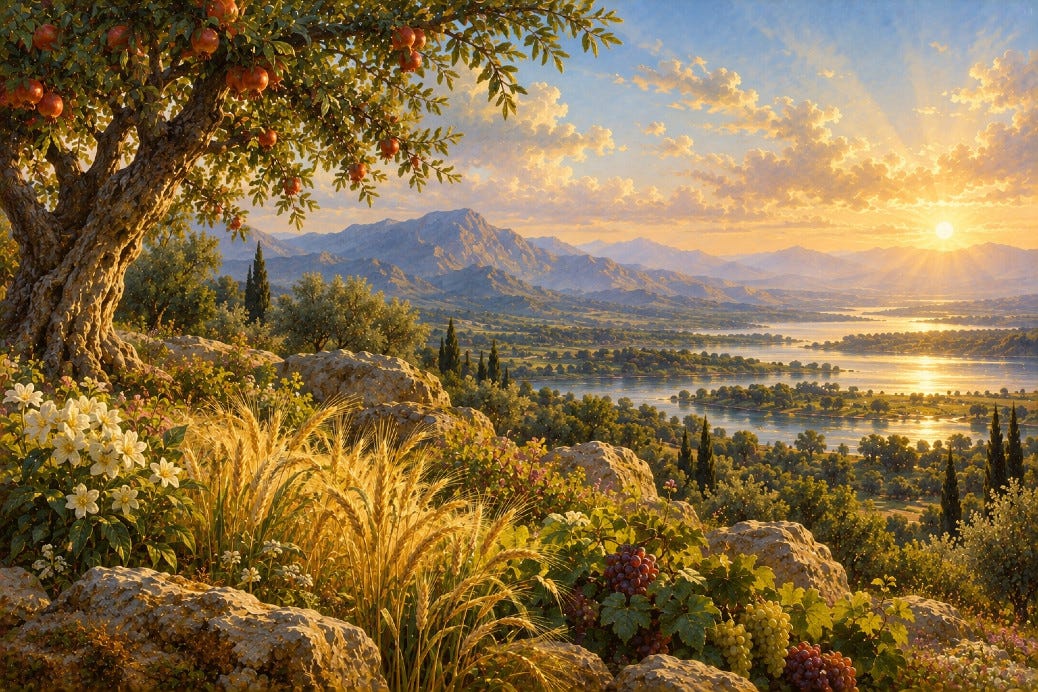
Scripture distinguishes three degrees among plants. The first it calls deshe, vegetation: plants that are not sown or cultivated by human beings, but grow spontaneously from the earth without cultivation, as Scripture says, “He causes grass to sprout for the animals”1 (Psalms 104:14), and, “Like a flower of the field, so does he sprout.”2 (Psalms 103:15). It is concerning this first degree that Scripture says, “Let the earth sprout vegetation”, meaning that the whole earth should clothe itself in vegetation.
The second degree is esev, plants that are sown, such as wheat, barley, and the various kinds of vegetables whose stalk does not renew itself year after year, as Scripture says, “And plants for the service of man, to bring forth bread from the earth”3 (Psalms 104:14). Concerning this degree Scripture says, plants yielding seed. It is also possible to understand the words upon the earth as connected with the preceding expression, “Let the earth bring forth”, as though Scripture were saying: Let the earth bring forth vegetation and plants upon the earth—that is, let them emerge upon the surface of the earth.
The third degree of vegetation consists of trees bearing edible fruit, whose trunks endure for many years. Concerning these Scripture says, “fruit trees producing fruit according to their kind”. According to the plain meaning, the expression fruit trees means that the fruit itself will produce fruit. A walnut, for example, is itself a fruit, yet it also produces another fruit by generating one like itself when it is planted in the earth. Scripture therefore adds, “whose seed is within it, upon the earth”, to explain how that fruit produces another fruit like itself: it does not do so by itself, but when the seed contained within it is placed in the earth through planting, that fruit then produces another fruit truly resembling it4.
In the ordinary course of nature, the generation of plants from seed always depends upon a preexisting seed, whether it was sown by one who cultivates the soil or remained in the ground and sprouted of itself. In the first and absolute Creation, however, this was not so.
Alternatively, “fruit trees producing fruit according to their kind” may mean that the fruit corresponds to the particular tree that bears it, for a tree does not produce whatever fruit might happen to arise. The words “whose seed is within it” would then teach that the seed is preserved within the fruit. The Creator of all things wisely ordained this so that the seed, which is the foundation for the continuation of the species, should be protected within it. Scripture then says, “And it was so, meaning”, as I have explained, that God decreed that this order should remain so permanently, so that plants would continue to reproduce throughout all the days of the earth.
From this you may understand that the formation of plants during the work of Creation differed from their subsequent formation according to the natural order in two respects. The first is that, in the natural generation of plants today, their forms derive from the influence of the celestial bodies. During the work of Creation, however, this was not so. Plants were created before the luminaries, through the power that He, blessed be He, imparted to the earth to bring them forth in their respective forms and according to their kinds, without any other external agent.
The second difference is that, in the ordinary course of nature, the generation of plants from seed always depends upon a preexisting seed, whether it was sown by one who cultivates the soil or remained in the ground and sprouted of itself. In the first and absolute Creation, however, this was not so. All plants came into being without any preexisting seed. The earth itself, through the power Hashem, blessed be He, had imparted to it, was sufficient to produce them without seed, without the influence of the stars, and even without any preceding rain. It brought forth its composite forms, the earth yielded its produce, and the tree of the field gave its fruit.
It follows from this that we should not accept the opinion mentioned in Bereshit Rabbah, according to which the vegetation created on the third day remained poised at the surface of the ground and did not actually grow until the sixth day, after God caused rain to fall upon the earth5. Ramban likewise departed from that opinion, and I too maintain that all the works of Creation were created in their full stature and complete form. Why should plants have been any less than the other created beings, so that in their case alone the divine command was not immediately fulfilled, as it was in all the other acts of Creation, without the intervention of their ordinary natural causes? As for the verse that led the Sages to this interpretation, “Now no shrub of the field was yet on the earth...” (Genesis 2:5), it will be properly explained in its place, and I shall demonstrate that no such conclusion necessarily follows from it.
Parashat Bereshit — Genesis 1:11-13, Before Seed and Rain in the Commentary of Don Isaac Abarbanel)
Next section →

