

Previous section → Before Seed and Rain
“Each According to Its Kind”
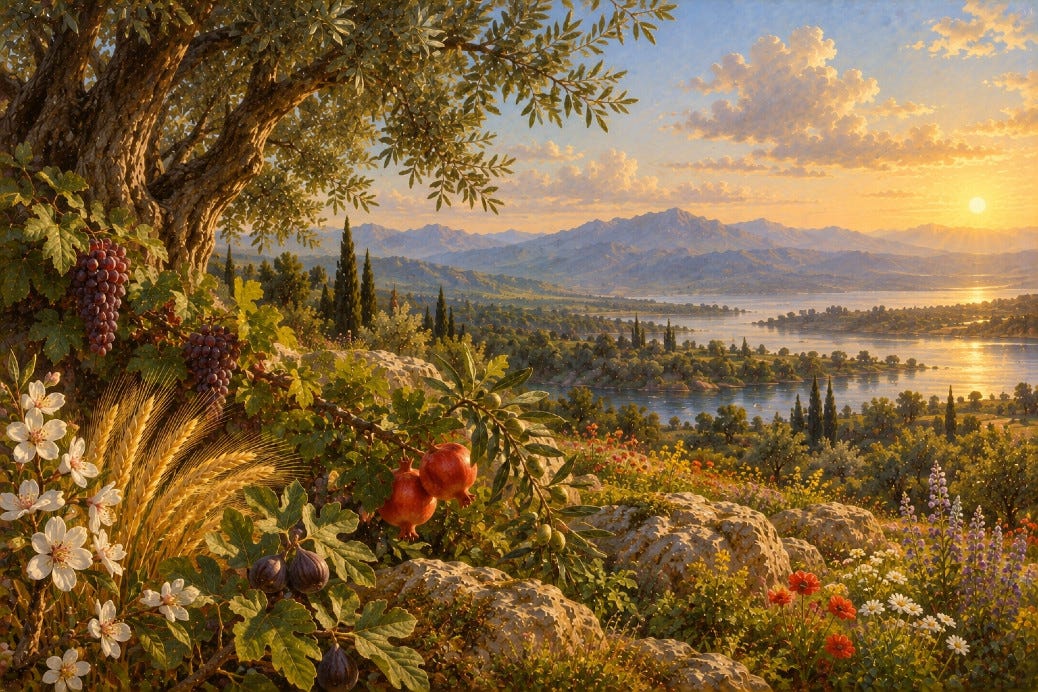
Scripture then relates that, at Hashem’s command, the earth brought forth all the degrees of vegetation that He, blessed be He, had commanded: vegetation and plants yielding seed according to their kinds. Our Sages found it difficult that in the divine command the expression according to its kind does not appear explicitly with respect to the vegetation and plants, and on this basis they offered the interpretation recorded in tractate Chullin, as Rashi mentions in his commentary1. According to the plain meaning, however, it seems to me that there is no difficulty at all. For the command says, “vegetation, plants yielding seed, fruit trees producing fruit according to their kind” (Genesis 1:11), and the expression “according to its kind” does not refer exclusively to the fruit of the tree, but also to the vegetation and plants: concerning each of them Scripture says, “according to its kind”. In recounting what the earth actually brought forth, however, Scripture states according to its kind twice for greater clarity—once concerning the vegetation and plants, which are the produce of the earth, and once concerning the fruit of the tree.
Concerning the trees, Scripture says, “a tree producing fruit”, rather than repeating “fruit tree”, as it had in the command2. This clarifies what I explained above concerning the words “fruit trees producing fruit”: their meaning is that the fruit contains within itself the seed through which its species is perpetuated. God therefore providentially fashioned the fruit in such a manner that the fruit itself, independently of the tree from which it came, can produce another fruit according to its kind.
Ramban has already asked why Hashem issued no command concerning the generation of non-fruit-bearing trees, since Scripture mentions only fruit trees producing fruit. Rabbeinu Nissim endeavored to answer this question. In my opinion, however, there is no real question here, nor consequently any need for such an answer, for there is no tree in the world that does not produce some kind of fruit. Even trees commonly regarded as non-fruit-bearing have fruits, such as galls3. Some trees bear edible fruit, while others bear fruit that is not edible but is nevertheless useful for other purposes and for medicinal preparations. In any event, every tree produces fruit. The sixth question is thereby resolved by what I have explained.
Why Scripture Says, “And Hashem Saw That It Was Good”
Scripture does not say concerning the vegetation, “And Hashem made”, or “And God created”, as it does concerning creeping creatures and the beasts of the earth. This teaches us that the vegetative form does not proceed from a separate agent in the same manner as the forms of sentient creatures and man, to which the language of creation and making is attributed, as will be explained4.
Although plants differ greatly in their size, powers, and longevity, He, blessed be He, saw that these differences were good and beneficial to the world and therefore made them so.
As for the statement concerning vegetation and plants, “And Hashem saw that it was good” (Genesis 1:12), it seems to me that it may be understood in either of two ways. First, Scripture may be teaching that the Holy One, blessed be He, saw in His wisdom that it was good for plants to come into existence before the luminaries, and for the coarse material earth to bring forth the vegetative soul without an external agent. Although all this was contrary to the ordinary course of nature, He saw that it was good for it to be so at the beginning of Creation, in order to make known that the hand of the Lord had done this and to distinguish the primordial Creation from subsequent natural generation.
Alternatively, Scripture may be teaching that although plants differ greatly in their size, powers, and longevity, He, blessed be He, saw that these differences were good and beneficial to the world and therefore made them so. Some are like Jonah’s kikayon, which came into being in a night and perished in a night (Jonah 4:10); others are like the green grass, which withers away, blossoming and flourishing in the morning but fading and drying by evening5. At the opposite extreme are the date palm and the carob tree, each of which may take seventy years to bear fruit6. Despite these great differences, Hashem saw that this order was good and beneficial for the world.
Scripture then says, “And there was evening and there was morning, a third day” (Genesis 1:13). This may indicate that all these things were accomplished within that continuous period of twenty-four hours comprising light and darkness. Alternatively, it may be because two different kinds of event occurred on this day: one associated with the evening, namely the appearance of the dry land, and the other with the morning that followed, namely the production of vegetation. A separate day was not assigned to each of them because vegetation is connected with and dependent upon the appearance of the dry land. Moreover, at the beginning of Creation it emerged from the earth itself and not through the agency of any external cause.
Parashat Bereshit — Genesis 1:11-13, The Order Within Diversity in the Commentary of Don Isaac Abarbanel)
Next section →

